


Small, daily choices shape lasting love. Discover why the little things in marriage matter—and how they keep relationships strong.
Love doesn’t fade all at once—it slips quietly through overlooked moments and missed connections. In this excerpt from The Two-Minute Secret to Staying in Love, Heidi Poelman reminds us that lasting love isn’t built through grand gestures, but through consistent, intentional care. Drawing from personal experience, research, and relatable metaphors, Poelman explores why the little things in marriage matter so much—and how small, daily acts of attention can keep love strong over time.
Have You Got a Minute? Why Little Things Matter So Much
“It’s the little details that are vital. Little things make big things happen.”
—John Wooden, UCLA basketball coach and winner of 10 NCAA championships
Loving our spouse takes conscious effort, but many couples today get swept up in the chaos of life and let love fall by the wayside. We have competitions, recitals, deadlines, and schedules that are constantly vying for our attention. We have a barrage of information, tweets, and texts always ready for our review. We have sports updates, advertisements everywhere, and endless pressures to succeed. How can we remember to show love to our spouse daily when there are days we hardly see each other?
For parents, the battle for time is even more difficult. Parenting has become busier than ever before as moms and dads seek to ensure their child has rock-solid self-esteem and a leg up on the competition. We enroll our three-year-olds in sports and music and camps, hoping that they can keep up with the neighbor kid, who is doing even more. We desperately want our kids to have every advantage, and we want them to know we love them and would do anything for them. That might be fine for the kids (for the most part). It’s not so good for marriage. Studies show that we spend far more time with our kids today than parents of previous generations, which leaves significantly less time to devote to our marriages. What do kids say when researchers ask what they want? They want parents who are happier and less stressed out!
I can relate to the transformation from loving and attentive newlywed to distracted, busy parent.
Scott and I met seventeen years ago at a college barbecue. A mutual friend introduced us, and we couldn’t be separated the rest of the evening. In the months that followed, I found myself falling hard. We talked until the wee hours of the morning, he brought roses and wrote poems, we dated, we danced. The whole thing was as natural and effortless as breathing—but substantially more exciting. Nine months later, with a ring on my finger, we began debating an August or December wedding. The only point in the December column was Christmas lights, so we started planning for summer.
The wedding was picture perfect, even with the rain that poured down on us. Everyone else ran from tree to tree trying to stay sheltered as we walked around for our photos. We couldn’t care less that we were getting soaked. In fact, I’m not sure we even noticed. My cheeks hurt from smiling at the end of the day. This was my ideal life partner, and our life together was going to be all roses and sunshine.
As newlyweds adjusting to our new life, we were still as happy as ever. No one else competed for our attention at home, and our only real responsibilities were to do well in our college courses and earn enough to pay for our 600-square-foot apartment and meals for two. We walked to school together, took classes together, shopped together, ate together, read books together, and played together. Showing our love every day in small and meaningful ways was easy.
Fast-forward a decade and then some. Things are a little different now. Responsibilities are many, and time is scarce.
Between us, we have four beautiful kids (ages two to eleven), a lovely home and two-car garage (attached with a mortgage and monthly car payments), a new business (with all the added excitement and stress that comes with that), church responsibilities, volunteer time at school, grocery shopping, daily meals and dishes for six, soccer games, playdates, dance class, piano practice, and homework. It probably goes without saying that the number of love sonnets I receive has reduced dramatically.
Some days, we don’t see each other for more than ten minutes as we both race in different directions. He’s out to the office and the gym. I’m up to exercise (on a good day), write, make breakfast, and get kids going. He’s working hard at the office. I’m working hard at home cleaning, cooking, carpooling, shopping, washing, folding, ironing, and finding moments to sit down and play with the kids. It’s a gift to raise a family with the partner that I love; I wouldn’t trade it or go back for anything.
Here’s the tricky part: showing our love to each other now takes more effort and deliberate attention than it used to. Much more.
We must be doing something right. We still often get what we affectionately refer to as “tingles” when we see each other at the end of the day. And it’s not entirely a matter of luck or even due to the fact that we both are fairly cheerful people. I can say that we are still best friends and more in love now than on the day we married. Partly, that’s because we focus on loving each other in little ways every day.
It takes attention, and in our modern day, our attention is stretched super thin. According to Dr. Edward Hallowell, a teacher at Harvard Medical School for more than twenty years and the director of the Hallowell Centers for Cognitive and Emotional Health:
“If you don’t have time to ponder and wonder, if you don’t have time to approach and avoid and put your heart into it, then love will falter here, not because you are a mismatch but because you have not created sufficient focus for love to grow. Attention given and received in proper measure over time, a recipe that varies from couple to couple, leads to a deeper interest in and a greater knowledge of the other person, which constitutes understanding and empathy. Mutual empathy creates a connection. It is impossible to overestimate the power of connection at its strongest. It drives life. But it cannot develop if people are unable to sustain attention over time. Such a mundane obstacle—distraction—ruins millions of potentially intimate relationships in our modern age.”
Many couples end the honeymoon stage of their marriage and become so focused on their own paths that they forget one simple thing: their relationship needs tending.
In the romantic comedy How to Lose a Guy in Ten Days, writer Andie Anderson is assigned to write an article on what women do to drive men away. So she finds someone to date. One thing Andie does in her attempt to get her new guy to throw in the towel is deliver a “love fern.” Andie dramatically explains to Ben that the fern symbolizes their love and that he must care for the little plant like he cares for their relationship. Later, Andie pretends to be horrified when she finds the plant withering. “You let our love fern die? Are you going to let us die?” The scene makes me laugh, but I also see some truth in the metaphor. Just as a fern or a garden needs daily attention, so does a marriage.
If you’re like my husband, and you love to exercise and be physically fit, here’s another analogy for you: Our bodies need regular exercise to stay healthy and to feel good. If we start to ignore the needs of our bodies, we may find ourselves with a little flab around the edges. We might start to feel more tired and run-down. We might not be able to do the same hikes or play the same sports that we once did. If we want to help our bodies feel and look their best, we must take care of them regularly. The same thing goes for love—daily doses keep the feelings strong.
Here’s one last image: Picture the love in your relationship as a fire.
The fire was easily lit with the sparks of falling in love. At first, the fire is hot and big and bright. For a while, the flames will continue on their own. Eventually, if the fire is ignored, the flames will become smaller and smaller, and go out. In marriage, simple, everyday acts of love and kindness add more logs on the fire. The more logs, the better, and the longer the fire burns, the deeper and hotter the coals in the fire become. With time, the love from a long-burning fire is far more fulfilling than it was when those flames were first sparked. That is the blessing of marriage.
A marriage needs everyday effort if it’s going to thrive.
It’s not the take-a-couple’s-trip-once-a-year kind of effort (though I’m definitely a fan of getting away every once in a while). Simple, deliberate acts will do. Something as easy as a love note, a genuinely happy greeting at the door, an expression of encouragement, or a foot rub after a long day will go a long way to show love to our spouse. As marriage researchers Dr. Carol Bruess and Anna Kudak put it, “even though small acts of affection might seem insignificant, the accumulation can result in something significant indeed.” Those loving and intentional connections keep the romantic flames alive.
It all starts with something as simple as your thoughts.
Two-Minute Action Steps
(Complete once and repeat often):
- Think about the little things your spouse has done for you that made you feel loved. Write down one thing that meant a lot to you, even if it may have seemed simple at the time.
- Remind yourself every day that the little things, done consistently, make a big impact.
- Think about the ways you can create a positive environment for your relationship. Every day for the coming week, think about one way you can have a happy impact on your spouse.
Unlock More Relationship-Building Secrets
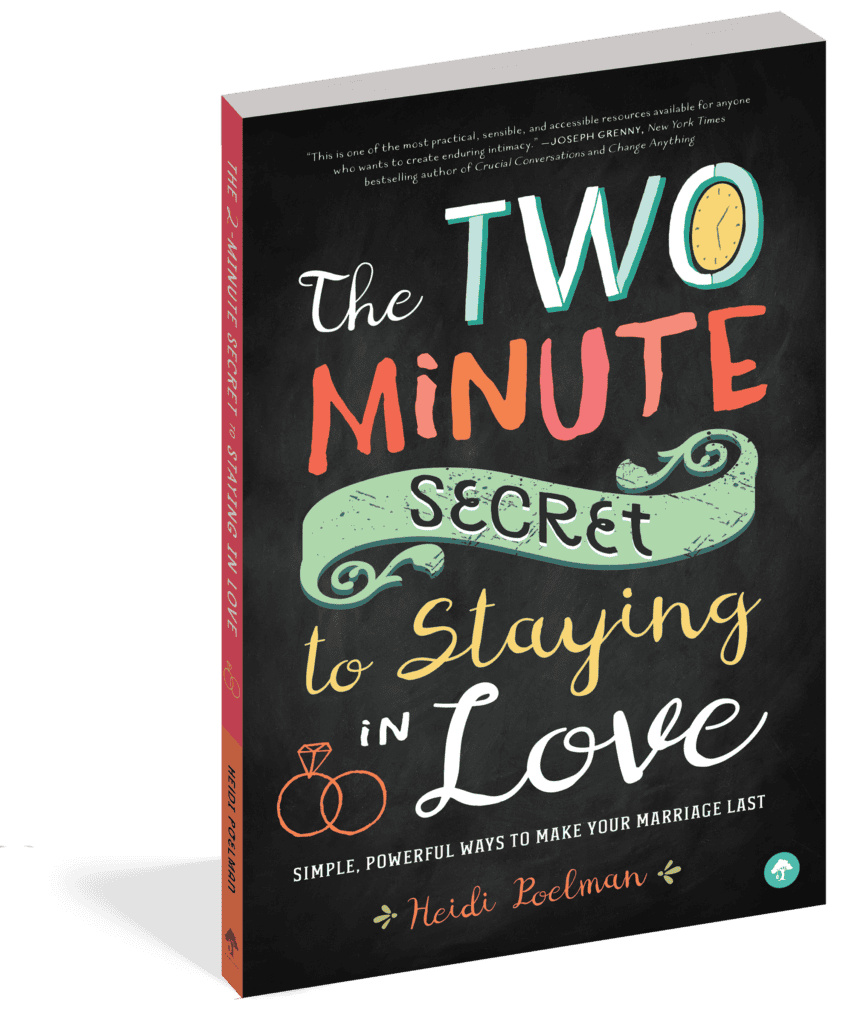
The Two-Minute Secret to Staying in Love
Excerpt from The Two-Minute Secret to Staying in Love by Heidi Poelman.