


Lost your temper and yelled at your kids? Here’s how to reconnect, rebuild trust, and parent with heart after yelling at kids.
Let’s face it—yelling happens. Even the most patient dads have moments where emotions boil over and voices get loud. What matters most is what comes after the yelling. In this excerpt from Dad Mode: 25 Ways to Connect with Your Children by Tal Eyre, we explore what to do when Dad loses his cool—a candid, thoughtful look at how to reconnect, repair trust, and move forward after a blowup. If you’ve ever walked away from an argument with your child feeling like the worst dad in the world, this one’s for you.
Way 8: When Dad Loses His Cool
Family life has a way of creating situations where frustration and anger can thrive (lack of sleep, lack of food, and disorder in the home, to name a few). We all know that losing our cool and yelling is a counterproductive option, but it is often the default action. Yelling can not only be scary for our children, but it also disconnects us from them. As we teach ourselves and our children to recognize when we are close to losing our cool, we lower the likelihood of actually having it happen. The purpose of this way is to help dads actively try to eliminate the number of times we lose our cool, which will, in turn, greatly improve our opportunities for connection with our children.
When Dad Yells
A few years ago, while on holiday, my family and I had just arrived at a beach. We hadn’t had lunch, it was windy, and we were all cranky. We got out of the car, and my daughter started to act up. She didn’t want to walk down to the beach because her socks were put on incorrectly.
I have to give immense credit to my partner, Anita. She was tired and hungry too, yet she had the patience and presence of mind to listen to our daughter when I was just about to lose it. I walked away and waited across the parking lot. I’m sorry to admit it, but when I am tired, hungry, or irritable, and my daughter cries and screams, I don’t handle it well. My partner finally got my daughter’s socks and shoes sorted out, and we got about halfway down to the beach when our daughter had another meltdown. At that point, I lost my cool and yelled at her that her behavior was unacceptable.
As I yelled, I saw her cringe at my words. I can imagine that my face was tense and the anger was very conspicuous. In hindsight, I may have looked pretty scary to this little girl who was already in distress. I stormed away, unhappy with my behavior, and my daughter continued crying.
It’s hard for me to relay this story because I am embarrassed with how I handled the situation, and I can see how damaging it was to my connection with my daughter.
As dads, we often run on little sleep and fail to get the sustenance we need. If we combine that with the stress of our professional and community responsibilities, we are primed to lose our patience.
What can be done?
In the book The Yes Brain, Daniel J. Siegel and Tina Payne Bryson use an image of a volcano to illustrate this point. They explain that parents and children can refer to the metaphor of a volcano to explain what is happening in our bodies when we are getting close to losing our cool (or having an eruption). “The Red Volcano” shows a volcano where the base is the blue zone where things are calm. The middle of the volcano is the green zone and it is an area where we often operate during our day-to-day tasks. Things get tricky when we are moving up towards the upper parts of the green zone. That is the area where we want to de-escalate any anger or building emotions because we want to avoid the red zone where an emotional eruption happens.
As dads, we can use a similar metaphor to explain to our children the concept of a volcano and how it relates to our human emotions. When something challenging happens, we can say something like, “What’s happening right now is upsetting me because I haven’t eaten and am tired. Because of these things, I am moving up the green zone rapidly and am getting closer to an eruption. I need to take a break to avoid losing my cool and yelling.” This communication signals to me and my child that I am aware of my building emotions and am trying to regain control before I lose my cool.
The Flooding
Relationship Psychologist Dr. John Gottman calls the state when we lose control and yell a flooding in the brain. He says flooding distorts our ability to think clearly as we are squarely in the “fight or flight” response. When we get flooded, Gottman recommends that we take a break for at least twenty minutes, but not longer than twenty-four hours before continuing to address the situation at hand.22 Better yet, if we can figure out how to avoid flooding altogether, we will not only maintain our connection, but we will also avoid a potentially highly disconnecting experience.
In the spirit of this concept of a volcano, we have created the following image, entitled “Volcano Dad” with a green cool zone, a yellow active zone, and a red eruption zone.
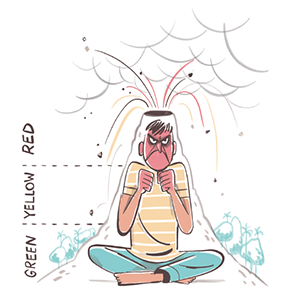
This image can help children (and dads) understand how to increase awareness of emotional states and regulate them to avoid eruptions. Using this image, we can explain to our children how we feel in each stage and that we want to de-escalate the situation whenever possible.
Way 8 Action Steps
- Show your children the Volcano Dad image. Explain how you feel in each stage (annoyed, upset, angry) and how you want to start eliminating eruptions.
- Be aware of your emotions before getting angry and verbalize them: “I’m trying hard not to yell, but this situation is making me frustrated and I’m starting to feel upset.” Or “I’m feeling a growing anger within me, and I’d like to take a break to cool off a bit and clear my head before we talk about this more. Can we meet back here in twenty minutes?”
- After you’ve calmed down, find ways to address the scenario in a calmer state and to repair the disconnection that this flooding experience (or near flooding experience) may have created (more on this in Way 9: A New Twist on Apologies and Forgiveness).
We all lose our temper at times, and this can create a major rupture in our connection with our children. When anger overwhelms us, our brain “floods,” and we are on high alert. Learning to recognize the impending arrival of this state and then verbalizing that we are heading toward an eruption can reduce the number of blowups we have.
Discover More Ways to Repair Your Relationship with Your Child
Dad Mode
Excerpt from Dad Mode by Tal Eyre.