


Read along to this excerpt to find out how you can be your own person in marriage by setting boundaries. And why you should!
They say that the more you spend time with someone, the more you become like them. But that’s probably not what you were signing up for when you said, “I do.” After the vows comes expectations and in-laws and arguments. So where in all of that can you still be your own person? Therapist and executive coach James Osterhaus answers that question and more in his book Questions Couples Ask Behind Closed Doors. And it all comes down to boundaries. Well-bounded couples will find more satisfaction in their marriage than poorly-bounded couples who constantly encroach on each other’s individuality. Read along to discover how Osterhaus recommends building healthy boundaries and cultivating individuality in a relationship.
How Can I Be Married and Still Be My Own Person?
They used to call her Patti. Her given name is Patricia, and her friends all call her Trisha, but to her mother, father, and siblings, she has always been Patti. She came from an upper-middle class family and married a young man named Ethan. While it’s true that “opposites attract,” Patti and Ethan were so completely opposite that they had almost nothing in common. In terms of cultural background, socioeconomic status, religion, career goals, interests, values, and education, these two came from different worlds.
“I was attracted to Ethan because he was different,” she recalls. “He was different from me, different from my background—and he was really different from my parents! They hated him! Ethan really set my dad’s teeth on edge. The more my folks told me how wrong he was for me, the more I wanted to be with him. It was really a rebellion thing. My parents never let me have a life of my own, never let me make my own decisions, and never gave me any privacy or freedom. To me, Ethan symbolized freedom from my parents and my upbringing.”
Unfortunately, the sense of “freedom” Patti sought by rebelling against her parents and marrying Ethan was short-lived. Soon after the wedding, she began to feel trapped in the marriage. “Ethan has no sense of responsibility about money,” Patti says. “Give him a dollar and it just burns a hole in his pocket. He just has to spend it, even if we don’t have it. He never stays with one job very long. So he goes out and has a great time while I get stuck with the bills, past-due notices, cutoff notices, and phone calls from creditors.”
But that’s not all. Patti discovered that by marrying Ethan, she had not gotten rid of one set of intrusive parents—she had actually added a second set.
Ethan’s mother would drop by unannounced, walking in the back door without even knocking. She would proceed to “hint” about how Patti should cook, clean, and care for her son Ethan (her “hints” were about as subtle as an M-1 Abrams tank).
What’s more, Ethan’s brothers and sisters were constantly borrowing things without permission—CDs and DVDs, clothing, and even Patti’s car. “When I married Ethan,” Patti seethed with bitterness, “I never imagined I was marrying his whole annoying family! We don’t have any privacy—none!”
In their own way, Patti’s parents were every bit as intrusive as Ethan’s family. “I know that husband of yours doesn’t provide for you,” her father would say, pushing a wad of money into her hands, “so here’s something to get you through the month.” If Patti refused it, he would leave it in Patti’s refrigerator or cookie jar when she wasn’t looking.
Patti’s mom, meanwhile, made a habit of stopping by every now and then to make sure that Patti kept a clean house . “You know how messy your room at home always was!” Patti’s mother would run her finger across the woodwork, checking for dust. She would even rearrange Patti’s furniture. No subject was off-limits to her mother’s prying curiosity—not even Patti’s sex life.
Through counseling, Patti discovered that a large part of her problem with parents and in-laws was that neither she nor Ethan had any boundaries in their family relationships.
Both families considered Patti and Ethan as children who were just “playing house” and who hadn’t really moved away from home. Since “we’re all just one big happy family,” Patti’s parents and in-laws saw no need to give her and her husband any privacy. Patti and Ethan urgently needed to draw some clear boundaries between themselves and their families of origin.
An Emotional Fence
A boundary is anything that marks a limit or border. The term implies a restriction and a defensive barrier. Boundaries say, “Certain people, certain actions, and certain intrusions are not permitted here. This is who I am, this is how I should act, and this is how you should act toward me. Anything that falls outside of these limits is not allowed.”
Boundaries draw clear, healthy distinctions between one individual and another. They are like fences with a gate, and you have the key to the gate. You decide whether to let anyone else into your boundaries or not. (For Patti and Ethan, these fences had fallen down and were being trampled on daily.)
An emotionally healthy couple is a well-bounded couple. Healthy couples are composed of people who have left their respective families and have established clear physical and emotional “out-of-bounds” lines between themselves and their childhood families— and between themselves and the rest of the world.
There’s a beautiful paradox in the process of separating from family and forming boundaries: it is our separateness that allows us to fully enter into a close and permanent bond with another person. In a healthy marriage relationship, two separate, well-defined people enter into a relationship so intimate that it borders on emotional fusion—yet each remains a unique and distinct well-bounded individual.
Healthy couples are composed of people who have left their respective families of origin to form a new family unit. When children become adults, their parents must release old emotional claims on them. Unfortunately, parents often cling to their adult children out of a sense of insecurity. They sometimes project their own feelings of inadequacy onto the child. This, in turn, causes that adult child to be hindered in taking responsibility for him- or herself.
The adult child must step out of the parents’ shadow and away from the parents’ grasp.
Unless both partners in a marriage are able to separate from their respective families, they won’t be able to establish a healthy boundary around their marriage. Without healthy boundaries, couples are vulnerable to repeated interference from dysfunctional family members.
There are several different kinds of boundaries that contribute to a happy and healthy marriage relationship, including control, time, emotional, and financial. The first is control boundaries. As an adult, you have a duty and a right to make your own decisions regarding your career choice, your finances, your friends, your marriage, your leisure time, where you choose to live, and how you choose to live. If you like, you can ask for the opinions of other people regarding those choices, but no one—not even a parent—has the right to manipulate or control you. When other people try to control you, it’s time to lay down some boundary markers.
Another boundary is time. If you have a parent who continually monopolizes your time, you need a firmer time boundary in your relationship. These boundaries may take the form of ground rules, such as “Mom, please call first before coming over to visit”, “Dad, please call at certain times,” “This isn’t a good time to talk; could we talk later?” or “I only have ten minutes to talk right now.” Avoid making phony excuses for getting off the phone. Just tell the truth, such as “Mom, I’ve got to get this laundry done. Call me tomorrow morning, and you can finish telling me about Aunt Sophie’s funeral.”
A person with healthy emotional boundaries is able to say to family members, “My sense of well-being doesn’t depend on you, and yours shouldn’t depend on me. I care about you, but I can’t be the answer to your emotional needs. I can’t allow you to intrude into the private places of my marriage.”
Family members who do not have clear boundaries between each other are said to be “enmeshed.” They unconsciously consider other family members to be extensions of themselves. That is why they don’t even realize that it is wrong to intrude on the lives of other family members.
Parents who are emotionally enmeshed with their children have trouble letting go. They don’t recognize or respect the maturity and separate personhood of their children. At the same time, however, the adult children of enmeshed parents have some responsibility for the lack of emotional boundaries. Often, in the painful or confusing dealings they have with their parents, they unconsciously allow or invite intrusions because it is emotionally comforting to retain some vestiges of being a child.
How do you draw emotional boundaries where they have not existed before? You do this by communicating clearly and firmly that you need to have boundaries in the relationship. It’s not necessary to say, “I need to pull back from you.” Instead, say, “I want to improve our relationship. I think it would be healthy for us both to find more time for our own goals and our own interests. You and I have taken too much responsibility for each other’s happiness and well-being, and I’d like to see us have a more balanced relationship. The fact that I feel a need for a greater sense of my own individuality doesn’t mean I don’t love you. Instead, I love you enough to be honest with you. This is going to be a great new chapter in our relationship.”
If there are specific areas of intrusion that need to be confronted, address them firmly yet graciously.
Stay focused on the issue and avoid accusing or bringing up side issues and past grievances. Be firm, yet positive, such as “Mom, I know you love me, but I don’t want you to ask me questions about my sex life or to rearrange my furniture anymore.”
The last boundary is financial boundaries. Money is a big issue in many families. Sometimes the financial needs of parents can strain the resources of their married kids, and sometimes it’s the other way around. Parents occasionally use money (either consciously or unconsciously) as a way to control their adult children. Whenever you accept money from your parents, you incur a debt, and that financial debt makes you vulnerable to being emotionally manipulated or becoming emotionally dependent. A financial debt to a parent can diminish our sense of mature personhood and self-esteem, making us feel like children again.
One sign that we have achieved full and healthy adulthood is that our financial life is completely separate from that of our parents. This doesn’t mean that one side can’t help the other with an occasional gift or loan. But the normal situation is for finances to be completely separate—that means we must set financial boundaries. To have healthy financial boundaries means that we take personal responsibility; we don’t expect our parents to continue providing for us. We prefer to put off purchases and scale back our lifestyle in order to live independently from others. Another way to have healthy financial boundaries is that we accept sacrifices in order to maintain our independence. If we find we are not succeeding financially, we take the necessary steps to cure the problem ourselves: an extra job, a tighter budget, cutting up credit cards, getting financial counseling, and so forth.
Remember, you have no obligation to impoverish yourself on your parents’ behalf, nor are they obligated to impoverish themselves or endanger their retirement in order to bail you out.
If you or your parents have trouble with spending, saving, investing, or debt, seek professional help and counseling. Your counselor can usually provide help or direct you to the resources you need. In the meantime, maintain clear, healthy financial boundaries between yourself and your parents.
An Enclosure of Safety
Boundaries enable us to maintain our selfhood and individuality within a relationship. The boundary a healthy couple builds around their relationship serves a double purpose. First, it keeps some things out. Second, it keeps other things in.
A well-bounded couple recognizes that certain people, certain actions, and certain words are off-limits. A person with clear boundaries does not flirt or respond to flirting with people outside the relationship. A person with clear boundaries does not act disloyally toward a partner by criticizing, ridiculing, or embarrassing him or her in front of others. A person with clear boundaries does not reveal secrets of the marriage relationship—sexual intimacies, shame issues, and so forth—to other people (except, when appropriate, to a counselor).
Boundaries create zones of protection and safety within and around the relationship. Just as each marriage needs a boundary around it, so each partner within the marriage also needs a boundary around him- or herself, a sense of protected individuality and identity. Each person in the relationship must be able to say to the other, “This is who I am as opposed to you. These are my thoughts, my feelings, my desires, my goals.” Personal boundaries within the relationship enable both partners to feel that their unique needs, abilities, and convictions are recognized and respected. These inner boundaries protect the identity, security, and individuality of both partners.
When you talk to a couple with healthy boundaries, you should be able to distinguish differences between them—different likes, goals, interests, wants, needs, ideas, convictions, and so forth. There are always real distinctions between people with healthy boundaries. If you find a couple consisting of two people who are virtually identical and inseparable in every way, then they probably don’t have adequate personal boundaries.
When there are clear boundaries within the relationship, it’s easier to build clear boundaries around the relationship.
With a foundation of mutual trust and respect, both partners can work together to maintain a clear boundary separating their own marriage relationship from the outside world. In every healthy marriage, there must be boundaries within the relationship and boundaries around the relationship. Boundaries within the relationship protect the individuality of each partner. Boundaries around the relationship protect the integrity of the relationship against intrusion from the outside.
While it’s important for each partner in the relationship to have individual boundaries and individual “space” within the relationship, it’s perfectly normal for couples to experience an enmeshment- like fusion in the early stages of the relationship. In the emotional hothouse of the courtship and honeymoon phase, couples commonly experience such an intense emotional bonding that they tell each other, “You are me and I am you.” Over time, however, the relationship cools down to a point where each partner sees the other as a distinct individual with unique differences and a need to be respected as a distinct first-person singular “I.”
Though healthy boundaries between partners are important, it’s possible to take boundaries too far. The couple that maintains separate finances and routinely takes separate vacations has erected walls of isolation instead of protective boundaries. Many couples live in a state of “emotional divorce”—they live under the same roof and eat at the same table, but they do not share any genuine intimacy. If you want to be married and still be your own person, you have to continually seek that delicate balance—two well-bounded individuals, distinct but not too separate, joined but not enmeshed, two partners unique in their intellect, creativity, ability, and viewpoint, but joined at the heart for life. \
What Happened to Patti?
As we saw at the beginning of this chapter, Patti’s parents and siblings used to call her Patti even though her given name is Patricia. Not anymore. “Patti” was Patricia’s childhood name, but now she has put away childish things. She has drawn the clear boundary lines of adulthood in all the relationships of her life. To symbolize the new boundaries in her life, she has asked her parents to call her Trisha, just as her friends do.
When a poorly bounded man and a poorly bounded woman come together, they create a relationship in which there are continual encroachments and trespasses against each other’s individuality. The relationship that results is painful and dysfunctional. But when a well-bounded man meets a well-bounded woman and they form a well-bounded relationship, they create a safe and nurturing enclosure where their relationship can thrive and grow. The paradox of the marriage relationship is that our well-bounded separateness actually allows us to enter into a close bond with another human being. When two people join to become one, both become more fully themselves than when they were single.
Take Action
Questions of a Marriage
If you and your partner are answering these questions together, first write your answers down separately, then compare your answers. But remember to use covenant-love to deal with any disagreements! Use the information you gather to better understand how each of you look at, and feel about, your love relationship.
1. Have you truly separated from your family of origin?
How well-defined are the emotional boundaries between you and your parents? To find out, take the brief Emotional Boundaries Test below:
Check true or false.
- I often feel guilty about spending too little time with my parent or parents.
- When I see or sense that my parents are hurting, I feel responsible. I feel I need to do something about it.
- My parent or parents rely on me as a source of happiness and emotional support.
- My parent or parents discouraged me from moving away from home.
- My parent or parents frequently shared intimate confidences and secrets with me.
- I feel closer to one parent than the other.
- I have been my parent’s best friend.
- I often share information with my parents that is really none of their business. (e.g., about my social life, finances, career decisions, and so forth.)
- One of my parents preferred my company to that of his or her partner.
- One of my parents told me or conveyed to me that I was his or her favorite or “special” child.
- My parent or parents did not want me to date or marry.
- One of my parents seemed overly interested in my sexuality or my body.
- I often find myself explaining or defending my parents to people.
If you scored four or more “True” answers in this quiz, then there is a strong likelihood that you have a problem with emotional enmeshment with your parents and need to define clearer boundaries with your parents in the emotional dimension of your relationship.
2. How much do you allow other people to control you?
What is a specific area of your life which you have allowed someone else to control during the past week? What could you have done differently to maintain a healthy boundary in that area of your life?
3. How good a job of you done in separating yourself from your family of origin?
What is a specific area of your life which you have allowed a family member to intrude across? What could you have done differently to maintain a healthy boundary in that area of your life?
4. How satisfied are you with the level of individual boundaries in your marriage?
How satisfied are you with the zone of safety and secure personhood you have in your marriage? To what extent do you feel your partner respects your individuality? How would you describe the present state of the boundaries between you and your partner (enmeshed, balanced, isolated)?
5. In what specific area of your marriage do you feel you need stronger, clearer boundaries?
What would you like to do differently in order to maintain a healthy boundary between you and your partner?
Discover Answers to Your Most Pressing Relationship Questions
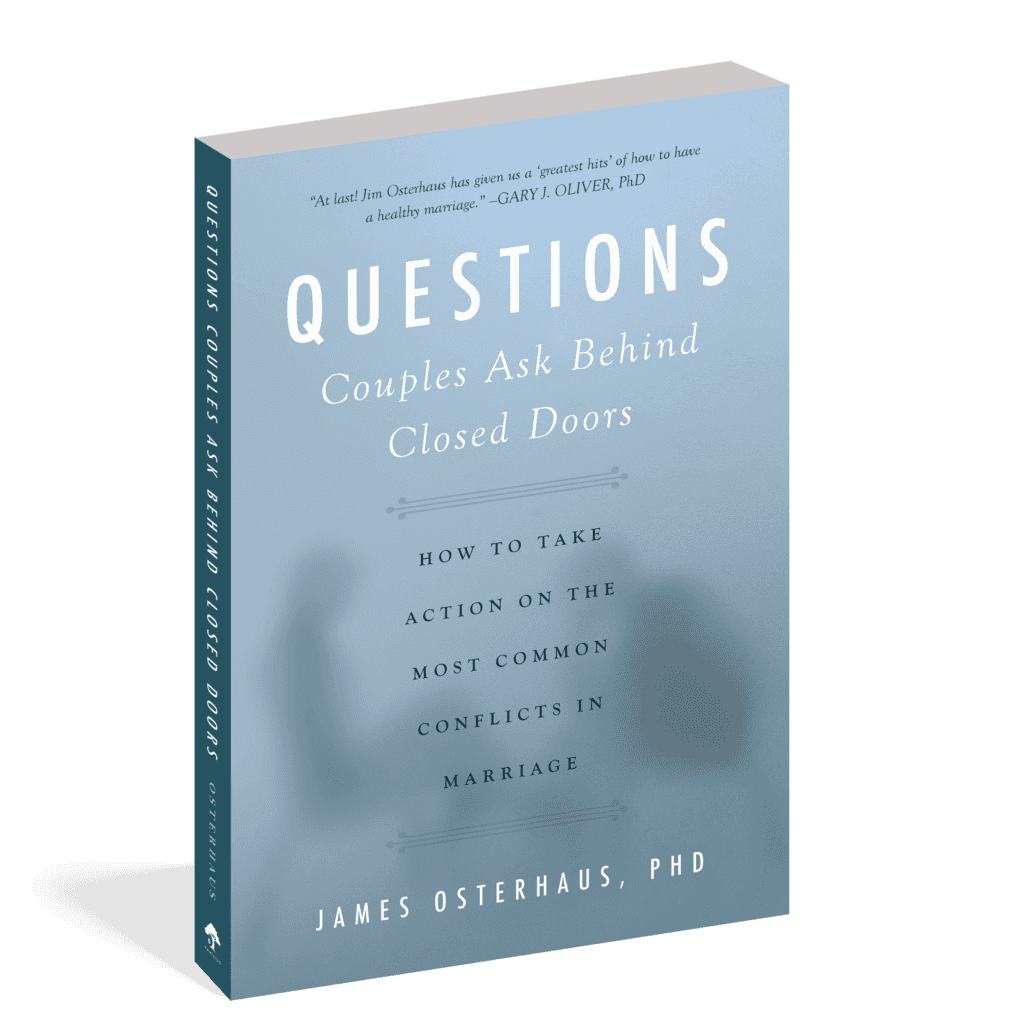
Questions Couples Ask Behind Closed Doors
Excerpt from Questions Couples Ask Behind Closed Doors by Dr. James Osterhaus.