

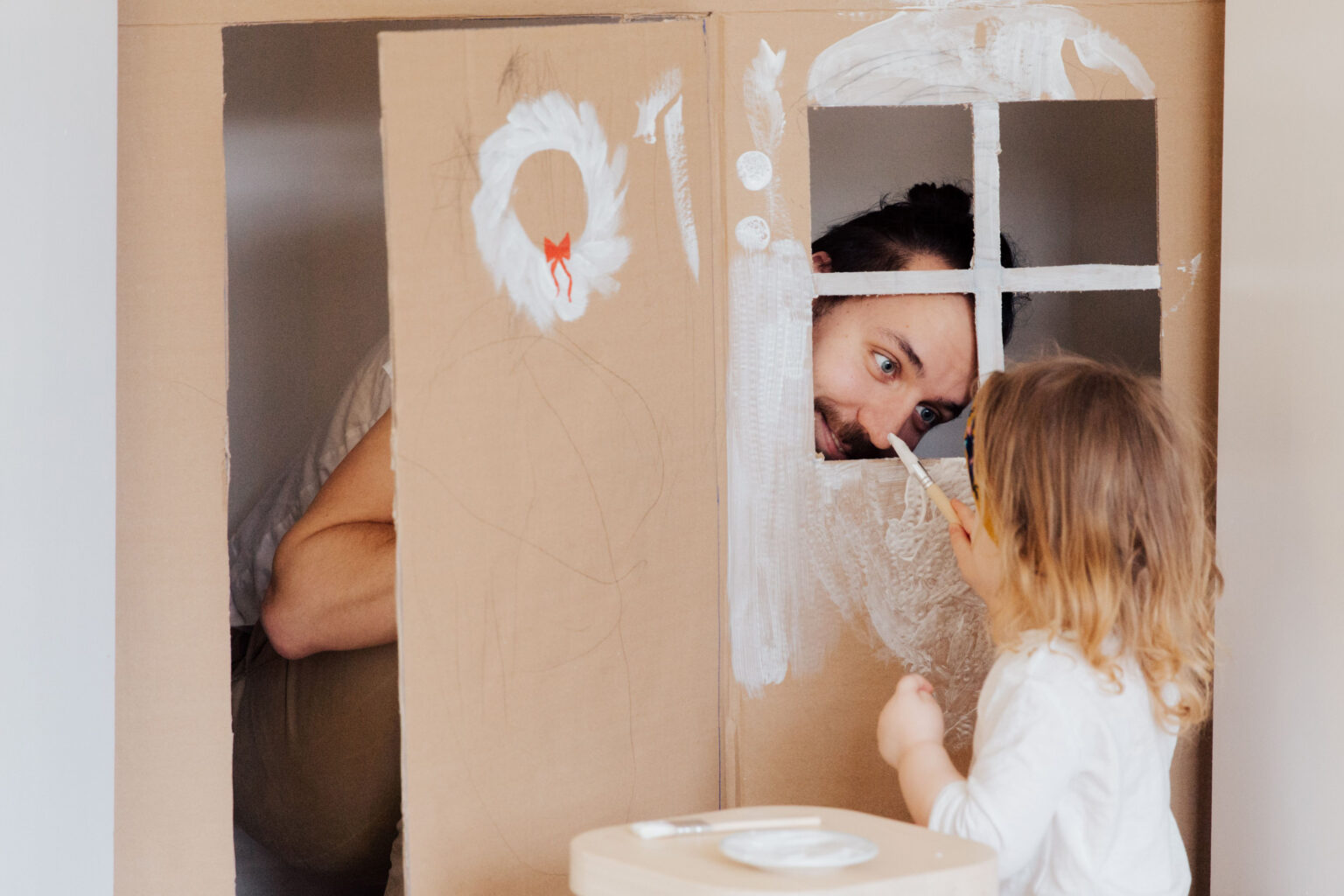
Discover how play-based improv rules can beat burnout and turn everyday parenting moments with your kids into magic adventures.
We’ve all been there: your child hands you a plastic block, insists it’s a prehistoric laser blaster, and looks at you with wide, expectant eyes. As exhausted adults, our default setting is often to shut it down with a tired smile or a quick distraction. But what if the secret to effortless, joyful connection was already mapping itself out on comedy stages?
By adopting play-based improv rules, you can bypass the burnout of forced playtime and step into a world where you don’t need a script to be a parenting superhero. According to Christopher Mannino’s expert advice in Making It Up, it all starts with two simple words that change everything: “Yes, and.”
Setting the Stage
I’m a former actor, but there’s no script for parenting.
And that’s the beauty of it, right there. The secret to what I’m going to show you is actually the same thing actors use when they step on stage and don’t know the lines.
That secret is improvisational theatre.
I’m going to walk you through the rules of improvisation and show you how to apply them to your own parenting. I’m going to show you that you don’t need a cartoon or fantasy to embark on a magic-filled adventure. The magic is real, and it’s in your child’s imagination, ready to embrace your own level of play. I’ll talk about the obstacles and the rough moments too. And I’ll show you how to create that seemingly mystical energy that the best parents seem to always have. Hint: it’s not just caffeine.
This book is step one on a journey with your kids.
Your worldview shattered when they were born. Now, hopefully, your approach to parenting will shatter once again. Play-based parenting can transform any caregiver/child relationship.
Just by making it up.
The Promise of Yes, And
It’s gonna be different. And it’s gonna be silly. But you’ll be great.
You’re likely reacting to that sentence with doubt. It’s daunting to step outside your comfort zone. However, once you master improv, playtime really is magic. We’re going to dive right into the rule at the heart of all improvisation—the promise that makes everything work.
The real tricky bit is that you’ve spent the bulk of your life being told to grow up. This is a truly unfortunate but necessary culturalization that involves learning rules and acting mature and all that other boring stuff. And yes, you’ll eventually encourage your own kids to grow up a little too. But not today. Because today you’re going to leave behind all the boring grown-up stuff and remember what it’s like to be a kid.
Let’s start with the promise that sets it in motion.
The foundation to all improv, and everything else in this book, is that one ridiculously powerful word: Yes.
Think about that time I played freeze with my son. Like any parent, I had a choice. Play along, or don’t. The easiest thing all parents learn is how to say “no.” Instinctually, you’re doing it right from the beginning. “Don’t chew that. Don’t touch that. Don’t do that.” And a lot of those nos are necessary. Babies are ridiculous when they’re born. I’ve never met a new human who didn’t come with the self-destruct switch turned on and the instruction manual missing. Seriously, they’ll put anything in their mouths and just jump off every ledge they see. Terrible initial design. Where can I leave a poor product review?
Still, once you grow accustomed to all the nos, one of the hardest words to say is “yes.”
Yet, the foundation to all improv, and everything else in this book, is that one ridiculously powerful word:
Yes.
When Gabby turned me into a snowman at the supermarket. I had a choice. I could chuckle and keep shopping. I could say “I’m busy,” or something to that effect. I could even give it a half-second acknowledgement before deciding it was silly and moving on. That’s not what I did. I took the improv approach.
The first rule of improvisation is the most important. It’s the one key that everything else depends on. And it’s two simple words: “Yes, and.”
That’s the rule. Yes, and.
The principle behind yes, and is simple, but the practice is hard.
Did I mention this whole chapter is devoted to just those two words? It’s true. Because countless parents and actors struggle with the concept. . . .
Let’s break them down.
Yes:
Yes, in this context, is the promise of acceptance. For many parents or caregivers, this is the most challenging step. Yet this is the moment that really decides it all. Accept the game, the reality, and the imagination. Or don’t. That’s the choice.
When you receive a piece of information, that information is true. It is the promise of the world. It is a new law.
For both parents and actors, this is far harder than it sounds. If your kid runs up to you, points a pencil like it’s a wand, and tells you to fly, what are you going to do?
Most parents, realistically, say “no.” This can take many forms such as “Oh, not right now,” or “I’m busy,” or “What are you doing?” It can even go so far as “I can’t fly.” If there is a negative response, that’s it. Finito. That moment of potential playtime is over. The opportunity has been lost.
And here, we begin to see the true brilliance of improv. Because improv shows us what can happen if we instead say yes. . . .
Saying yes may be the hardest lesson in the book. And it’s not just at the beginning of playtime either. Saying yes has to continue throughout playtime, and throughout an improvisation.
When teaching improv to high schoolers, I always began with a lesson on yes, and. I described the process like building a tower brick by brick.
In a two-person scene, each idea is a brick. Brick is a term used to represent any concrete idea. A brick is essentially a promise or rule in the scene. These bricks become the foundation, and ultimately the walls, of a tower. When a brick is placed, the other actor has only three choices: they can knock that brick down, ignore the brick completely (which is a different form of saying no), or can build on top of it.
Guess what? It’s the same when playing with kids. When they give you suggestions, or bricks, you have a choice of how to respond. You can deny, ignore, or accept the brick. Once you accept it, you move to the next step. You have to keep building.
And
Once you have an idea, you have to add to it. Only saying yes is a form of acceptance, but you won’t be helping to build. And if you just keep saying yes to the bricks without adding, the kid is the only one participating. You aren’t playing with them, you’re watching them. . . .
This is the heart of the Making It Up Method.
If you accept the reality presented—the bricks placed either by you or the child—you must then add to it. Every idea, every brick, keeps the play going.
Similarly, every episode of Bluey works because in each episode, the family spends seven minutes continuing to say yes, and to each new idea. They take the promises of the game, accept them, and build upon them. In the episode “Bus” for instance, the family sets up the chairs. The chairs are a bus (brick). The two children, Bluey and Bingo, are grannies on their way to mahjong (brick). Their dad is the bus driver (brick). Their mom is a separate passenger secretly in love with the driver (brick).
With every line in the seven-minute episode, a new brick is added, accepted, and built upon, from the steering wheel breaking off to the bus driver’s rejection of the mother because he’s already married to a giraffe. Line by line, the episode follows the course of an improv. It builds, brick by brick. And it’s fun.
Adding a brick, or idea, to an improv keeps the scene building, keeps the play going, and frankly keeps things entertaining. The “and” in yes, and is just as important as the “yes”. It ensures that everyone is participating, and everyone is playing equally. . . .
It doesn’t matter if you’re an actor. You’re the main player in the intense playtime that your child wants.
You’ve already been cast, and this method is all you need. You’re the star of this show. Keep saying yes, and.
Discover More Play-Based Improv Rules to Bond with Your Kids
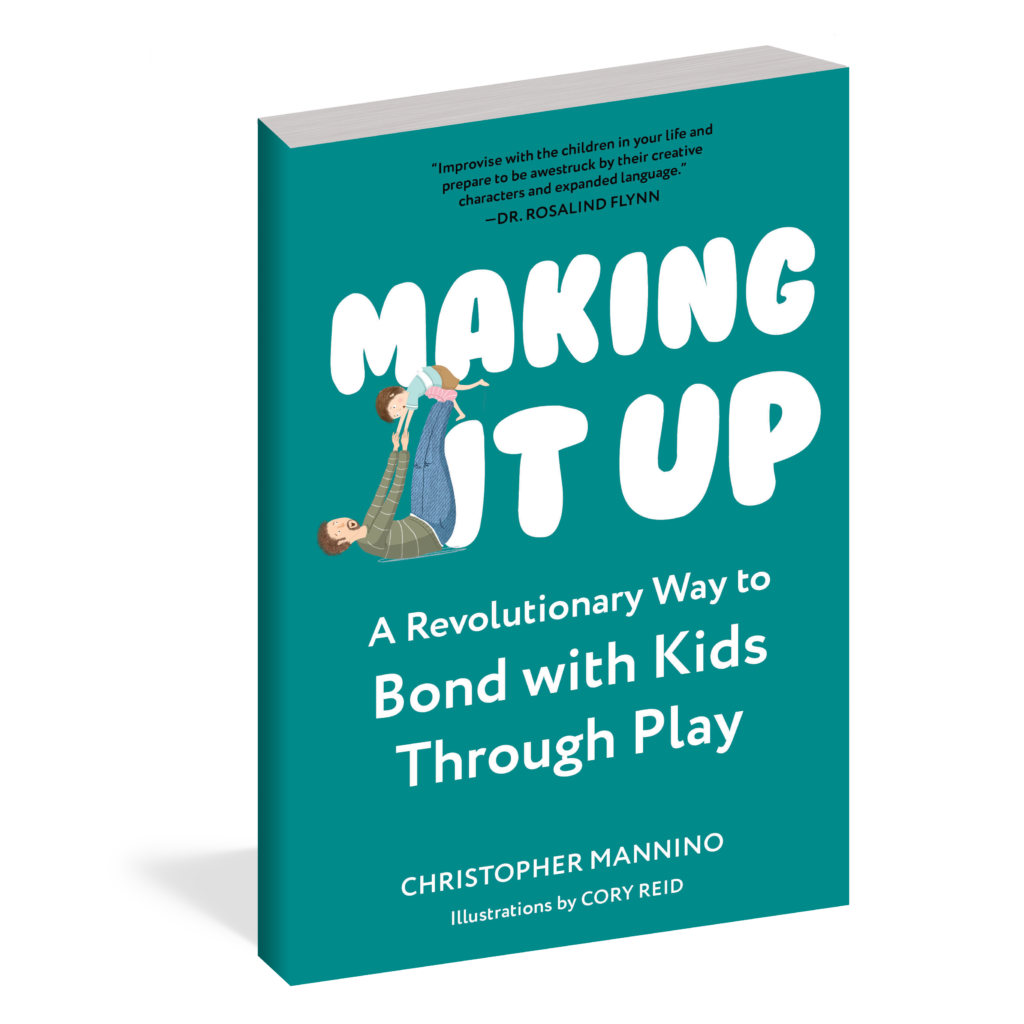
Making It Up
Excerpt from Making It Up by Christopher Mannino.