


Does hiding the truth protect children—and yourself—from grief? Join Lisa Sugarman in this gentle guide to talking about suicide loss with kids.
There’s no good time to tell a child that someone they love has died by suicide.
There’s no perfect sentence. No script that makes it hurt less. And no magical combination of words that will protect them from the reality that someone they loved is gone forever.
And when you’re grieving that same person too, trying to find the right words can feel almost impossible.
How are you supposed to help your child understand something you may not understand yourself? How do you answer their questions when you’re still asking so many of your own? How do you reassure them that they’re going to be okay when, in that moment, you’re not entirely sure you believe you’re going to be okay either?
I know something about this because I was that child.
What Happens If We Hide the Truth of Suicide Loss from Kids?
I was 10 years old when my father died by suicide. It was August of 1978, just days after my 10th birthday. Only I didn’t know my father had died by suicide. My mother told me he’d had a heart attack, and I believed that story for the next 35 years.
She wasn’t trying to deceive me. She was trying to protect me from another layer of pain on top of the one I was already trying to navigate. And she did.
My mother had just lost her husband and become a single parent overnight. And she was suddenly responsible for helping me survive the most devastating loss of my young life while she was trying to survive that same loss herself. On top of all of that, she was carrying the truth about how my father died completely alone, sharing the truth with no one.
It was the 70s, and suicide wasn’t something people talked about the way we’re talking about it today. There was enormous stigma and shame attached to it. And there weren’t conversations about age-appropriate language or how to support children after a suicide because people just refused to acknowledge that kind of loss. So my mother was doing the best she could with what she knew at the time, and she believed the truth was simply too heavy for a 10-year-old to bear. And at the time, she was right.
So she carried it for me.
And I grieved without it.
For 35 years, I believed my father’s death was something it wasn’t. I grew up, got married, became a mother myself, and lived most of my adult life without knowing this fundamental piece of my own story.
Then, when I was 45, the truth eventually came out.
Children who learn the truth later will experience grief again.
I often say I lost my father twice: once when he died and again when I learned how he died. The second loss didn’t replace the first, it just added an entirely new layer of grief to a loss I thought I’d already spent 35 years learning how to live with.
Learning the truth forced me to revisit my grief from an entirely different place. Suddenly there were new questions. New emotions. New pieces of my childhood that I had to look at again through a completely different lens.
But there was also something incredibly important that came with knowing the truth: I finally had the whole story.
And that experience has shaped so much of what I believe about talking to children about suicide loss today.
We can’t protect our kids from grief by protecting them from the truth.
What we can do is give them the truth in a way they’re able to hold. Then we can sit with them as they sit with that truth.
How to Talk to Kids About Suicide Loss
Telling the truth about suicide loss doesn’t mean giving a young child details they aren’t developmentally ready to process. It means being honest in simple, clear, age-appropriate language and allowing the conversation to grow as the child grows. It doesn’t have to be one perfect conversation where you somehow find exactly the right words and answer every question. In fact, it probably won’t be. And that’s okay.
Your child doesn’t need a perfectly composed parent sitting across from them with every answer. They need someone they trust who’s willing to be honest with them.
And that might sound like, “I don’t know.” Or, “I’m really sad too.” Or it might mean crying while you’re talking.
A Common Misconception
One of the things I think we sometimes misunderstand about protecting children is that we believe they shouldn’t see us hurting. We want to be strong for them, so we hide the tears, leave the room when we fall apart, or pretend we’re doing better than we are. But we shouldn’t. Because there’s a difference between asking a child to carry your grief and allowing them to see that you have grief too.
It’s okay for your kids to know you’re sad. In fact, I think there’s something incredibly important about showing them that sadness isn’t something they need to hide.
You can say, “I’m crying because I miss Dad. I’m really sad right now, but I’m okay, and you don’t have to take care of me.” And that last part matters because kids are incredible observers. Kids are always reading the room, even when we think they aren’t.
You Are Your Child’s Safe Space
After a suicide, kids may be carrying fears and questions they don’t know how to articulate.
They may be thinking, Was it my fault? Could I have stopped it? Did they leave because of me? Is this going to happen to someone else I love? Could it happen to me?
And those questions need somewhere safe to land.
That’s why one of the most important things we can tell a child after a suicide is that they didn’t cause it. Nothing they said, did, didn’t say, or didn’t do made this happen. And that reassurance will need to happen more than once.
Then let them ask questions. Even (and especially) the uncomfortable ones.
Don’t Be Afraid to Talk About It
Remember, you don’t need to give graphic details or information your child isn’t ready to understand. Answer the question they’re actually asking.
For a younger child, you might start simply: “They died by suicide. That means they were hurting very deeply and weren’t able to understand that there were other ways to get help. I know that may be hard to understand, and you can ask me anything you want about it.” Then let their questions guide you.
Older children and teenagers may want or need to know more. What matters is that they understand this isn’t something your family is afraid to talk about. That part is crucial.
And if you don’t know the answer, say that.
Say, “I don’t know why.” Or, “I wish I understood too.” Or, “We may never know everything they were feeling.”
There’s so much about suicide that those of us left behind are forced to live without knowing—things like the why, what someone was thinking or feeling, or whether anything could have changed the outcome. We shouldn’t feel like we have to invent answers just because our kids are asking for them.
4 Important Steps for Teaching Children (and Yourself) to Live with Suicide Loss
If you’re having these conversations with a child while navigating your own grief, here are four things I hope you’ll remember.
- Tell the truth in a way your child can understand. You don’t have to tell them everything, but give them something truthful to build on. Children grow, their questions change, and the conversation can grow with them. This isn’t one talk. It’s an ongoing relationship with the truth.
- Make it clear that they’re NOT responsible. Say it even if they haven’t asked. Say it more than once. Children can fill in the blanks when they don’t understand something, and sometimes the story they create is much scarier than the truth. Make sure they know this wasn’t their fault and it wasn’t their responsibility to prevent it.
- Let them see that grief doesn’t have to be hidden. Cry. Say the person’s name. Tell stories. Laugh when something reminds you of them. Let your child know that missing someone and continuing to live can happen at the same time. You’re not teaching them how to “get over” a loss. You’re showing them how to live with one.
- And please, give yourself that same grace.
You Are Allowed to Need Help Too
Don’t forget: You’re trying to parent while grieving. You’re trying to answer questions while carrying your own. And you’re trying to create safety for your child while your own sense of safety may have been completely shaken.
You’re allowed to need help too.
Reach out to a grief counselor. Find a suicide loss support group. Lean on family and friends. Find age-appropriate bereavement support for your child if they need it (and yourself). You don’t have to be their only source of support, and you shouldn’t have to carry your own grief alone either.
I think often about how different my own childhood might’ve been if the world had understood all of this in 1978.
I don’t say that to blame my mother. In fact, it’s very much the opposite. Becoming a mother myself gave me an entirely different appreciation for the impossible position she was in. She was trying to save me from a kind of pain she believed was too heavy for a 10-year-old to carry while carrying an unbearable amount of pain herself.
That’s why I understand the decision she made. And I’m grateful to her for making it.
I also understand what silence can cost.
Suicide Loss Isn’t Painless, But We Can Heal Together
The tension between a mother desperately wanting to protect her child and a child needing the truth about her own life is an important part of my newest book, Surviving: Finding Hope After Suicide Loss. In the book, I write about losing my father at 10, learning the truth 35 years later, and what happened when my mother and I finally began talking openly about the secret she’d carried for so long.
But Surviving is far more than the story of what happened to us. It’s also a resource for the people trying to figure out what comes next after suicide loss, including how we talk about suicide, how we support the people who are grieving, and how families can begin healing together.
Because we can’t make suicide loss painless for our children, even though we wish we could.
But we can make sure they don’t have to navigate it alone.
We can tell them the truth in words they can understand. We can remind them that they’re loved and that they’re not responsible. We can give them permission to ask questions today, tomorrow, five years from now, or whenever those questions come.
And maybe most importantly, we can show them that grief isn’t something a family has to hide from each other. It’s something to experience together.
We Don’t Need to Have All the Answers
I spent 35 years living inside the silence surrounding my father’s suicide. And if my experience has taught me anything, it’s that our kids don’t need us to have all the answers. They just need to know they can come to us with their questions. So show up. Have the hard conversations. Tell them the truth in a way they can understand. And then keep showing up for everything that comes after. We can’t take away their grief. But we can make sure they never have to carry it alone.
Discover More Strategies for Talking About and Healing from Suicide Loss
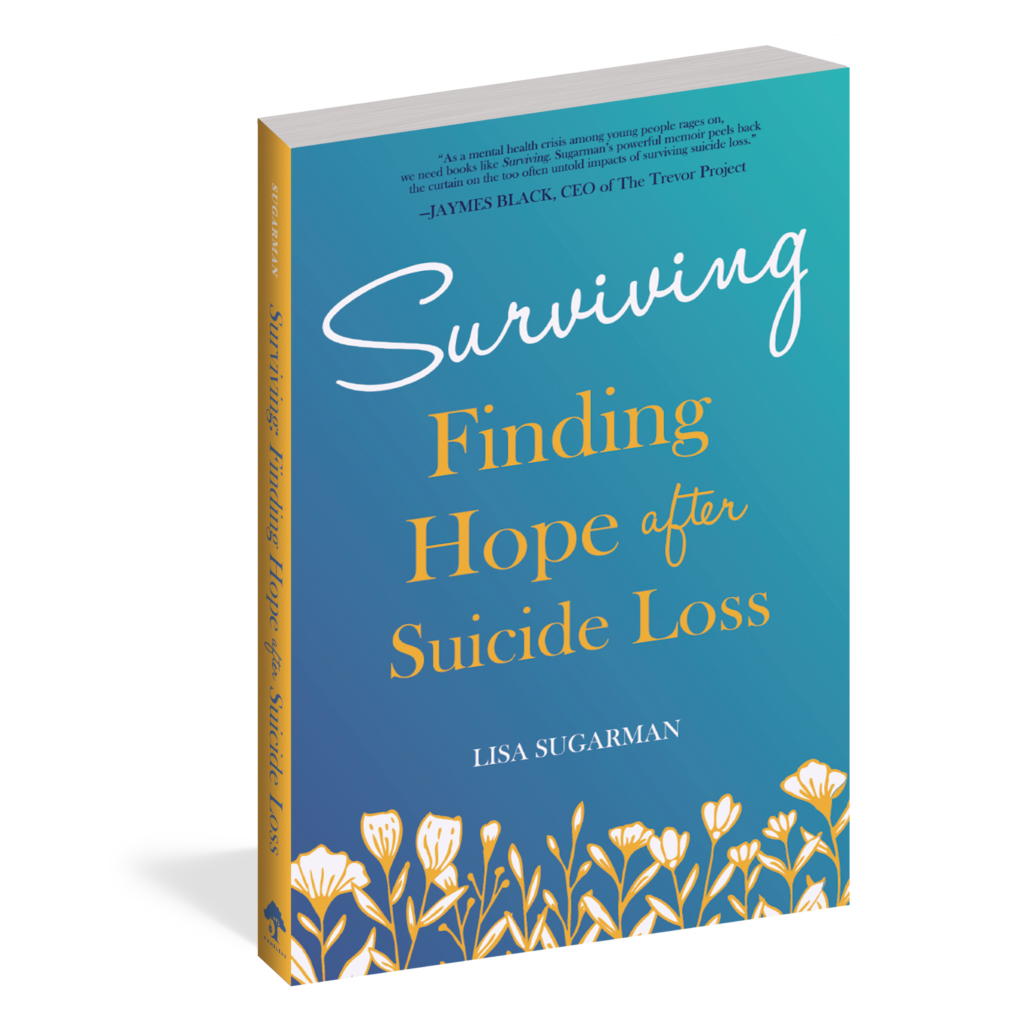
Surviving: Finding Hope After Suicide Loss
Lisa Sugarman is a three-time suicide loss survivor, author, and leading mental health advocate. She’s a crisis counselor with The Trevor Project and a storyteller with NAMI, using her lived experience to help others heal through connection and community.
She’s also the founder of The HelpHUB™, a free online platform offering inclusive mental health resources, crisis support, and treatment options for every community. Lisa cohosts The Survivors Podcast and is the author of Surviving: Finding Hope After Suicide Loss (2026) and three previous books on parenting and embracing our perfect imperfectness.
A Safe Place facilitator and board member with Samaritans Southcoast, Lisa’s work has been featured on the Mental Health Television Network and on platforms like Calmerry, Recovery.com, Healthline Parenthood, Grown & Flown, TODAY Parents, The Washington Post, and Psychology Today. She lives and writes just north of Boston.