


Discover why new parents experience conflict and learn how to protect your relationship after having a baby with Karen Kleiman.
Navigating life with a newborn is a beautiful, chaotic whirlwind. But it can also take an unexpected toll on your marriage. Have you found yourself asking “what about us?” lately? Maintaining a healthy relationship after having a baby is one of the most common hurdles for new parents.
We want to offer some much-needed comfort and clarity. So we are sharing an exclusive excerpt from Karen Kleiman’s What About Us? This gentle, accessible guide is the sequel to the bestselling Good Moms Have Scary Thoughts. (It is also the prequel to her upcoming book, Unchecked: OCD and Intrusive Thoughts After Having a Baby.)
This excerpt blends expert guidance with validating illustrations to provide a compassionate look at new parent relationships. It’s the first step to protecting your “circle of affection” amidst the beautiful mess of parenthood.
To All New Parents
“What happened to us?” we hear couples express woefully in therapy. “We used to be so carefree, so fun, so in love. Now, all we do is bicker and snap at each other.”
When couples first navigate intimacy in a committed relationship, they generate something called a circle of affection (Kleiman, 2014). Imagine a circle that encompasses the two partners and all their individualities, predilections, desires, passions, and values. It’s a circle that envelops the two of you and everything you enjoy and hope for. It’s just “you and me.” This circle connects you to each other with the promise of shared dreams and the challenge of potential struggles. The circle of affection is what keeps you tuned into each other, creating a protective bubble—despite the pull from external life forces, such as work, financial stress, loss, other dysfunctional relationships, just to name a few. This is where it has always been “all about us.”
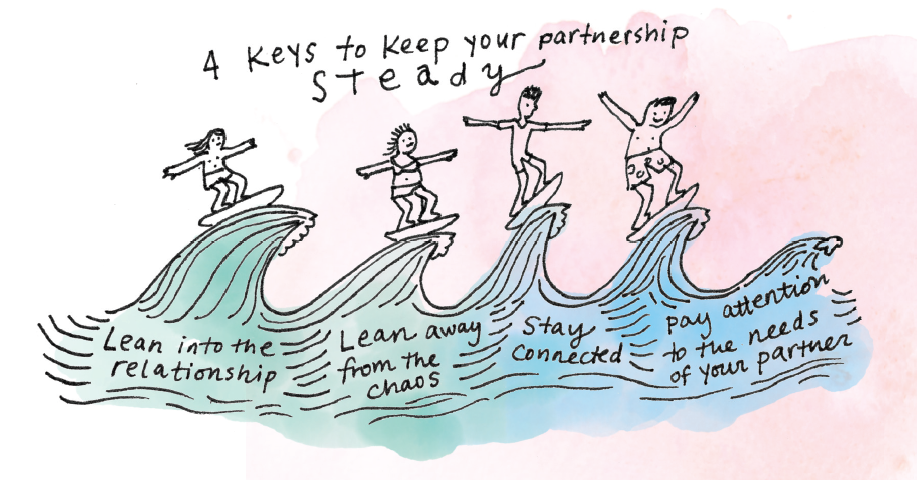
Partners do their best to sustain this connection by paying attention to the relationship. By taking care of each other. By listening to what is not being said out loud. By considering the needs of your partner, which at times take priority.
Research shows that when couples attend to the needs of their partners, both individuals report greater happiness and longer-term satisfaction, thus nurturing and maintaining the circle of affection.
When we add a baby to this picture, the external stressors impacting the circle of affection intensify. Couples are often surprised to discover they may not have the skills to respond adaptively. When we factor in variables such as sleep deprivation, hormonal changes, predispositions to depression and anxiety, and different personalities, it’s no wonder each individual in a partnership feels overwhelmed and stretched beyond capacity. The tension that emerges in response to the unrelenting demands and stressors can be misinterpreted as a sign that something is either wrong with the relationship or that the baby is coming between them. While all emotions are heightened during this major life transition, anxiety especially runs rampant and, if left unchecked, can rapidly accelerate, leaving new parents feeling unsupported and downright miserable.
The addition of a baby is as disruptive as it is exhilarating.
As couples are thrust into the demanding task of caring for a newborn, they find little or no time to attend to their relationship. Tedious tasks replace romantic gestures; chats about bodily functions are the new center of intimacy. Couples often find themselves lost in the busyness. The urgency of caring for an infant transcends anything and everything. Any reference to or silent wondering What about us? leads to the same answer: We have to wait. Consequently, the relationship is put on the back burner.
Wait until we get some sleep. Wait until I can hear myself think. Wait until I can take a shower without someone screaming my name. Wait, I can only do so much at one time. WAIT.
Withstanding the strain of 24/7 baby care, the relationship often takes a huge hit, no matter how loving, no matter how connected, no matter how well-intended. It makes sense that partners are preoccupied and can only focus on the adorable tumult inundating their senses. Nonetheless, amidst the excitement and the unpredictable stressors, one or both of the partners can suddenly feel overwhelmed and utterly alone.
Research has taught us that this primary relationship must be attended to, especially during times of high stress.
It has been shown that a whopping 67 percent of new parents experience conflict, disappointment, and hurt feelings after having a baby (Gottman, 2008). When comparing couples with and without children, research shows the rate of decline in relationship satisfaction is nearly twice the rate for couples who have children than for childless couples (Doss et al., 2009). Moreover, a poor marital relationship is the most consistent psychosocial predictor of postpartum depression (Beck, 2001). Support from a partner can actually protect against depression in both mothers and fathers. Even without the presence of a clinical depression or anxiety disorder, both men and women are vulnerable to substantial anxiety, which can interfere with the bestlaid plans.
Our vision for What About Us? is to teach you how to adapt to this unprecedented stress by providing skills aimed at reinforcing your circle of affection and helping you tap into your strengths as a couple. Consistent with our first book, Good Moms Have Scary Thoughts, each page will have a comic depicting a common stressor, followed by text, which will describe and validate the issue the couple is confronting, along with a journal doodle offering specific skillbuilding exercises. This book provides evidenced-based solutions to areas of vulnerability or conflict that can arise during the perinatal period (i.e., pregnancy and postpartum) and support for stress that is hard to put into words. We are hopeful that this resource will help you take care of your relationship while you are so busy taking care of everything else.
This Is Us?
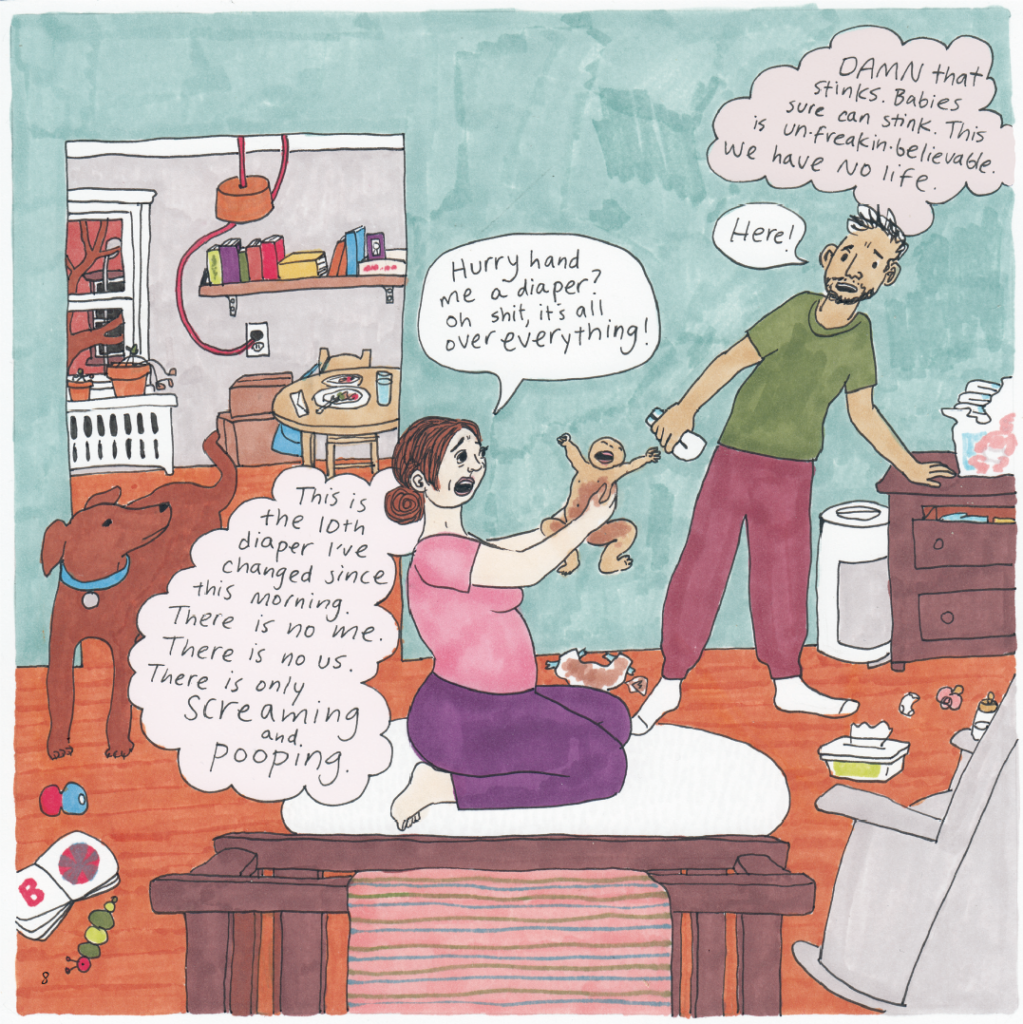
A Wonderful Mess
Having a baby is hard on a relationship. It seems that no matter how much they prepare, couples are often stunned by the absolute chaos that quickly descends upon them. While it’s hard to prepare for sleeplessness and ear-piercing cries, couples that anticipate some degree of turmoil seem to cope better, with less bitterness and greater satisfaction, than those who feel blindsided. Alongside the excitement, constant worries and bickering will test your relationship like never before. Lack of sleep and short tempers can lead to snapping, blaming, and all kinds of resentments.
Still, relationships can endure high levels of stress when they are fortified by mutual support and attention. Understanding and talking about the fact that this life transition will substantially impact your relationship are the first steps toward protecting it.
Find More Tools for Bolstering Your Relationship After Baby

What About Us?
Excerpt from What About Us? by Karen Kleiman.