


Discover the three degrees of failure and how redefining them can turn blunders and catastrophes into powerful growth opportunities.
For most of us, failure isn’t just a bad moment—it’s a label. From small blunders to full-scale catastrophes, the very idea of “failure” can feel like a final judgment. But what if we could erase failure entirely? In this excerpt from Fail Brilliantly by Shelley Davidow, DCA, and Paul Williams, PhD, you’ll explore the three degrees of failure and the revolutionary perspective that frees us from its grip. Instead of assigning value to our missteps or viewing them as permanent setbacks, this approach invites us to replace the word “failure” with new concepts—ones that open doors to growth, creativity, and genuine success.
By learning how to erase failure, we can transform not only our resilience but our very definition of achievement. Whether you’re recovering from a stumble or navigating a life-changing detour, these insights offer a fresh path forward—one where the fear of failure no longer has the power to hold you back.
From Blunders to Catastrophes: The Unexpected Outcome as a Force That Shapes Us
Despite your best efforts and learning from past failures, you have failed to become the success you dreamt of being. You have pasted “Never Give Up” signs on your bathroom mirror, and you feel you have been at it 24/7 since you were at school. But after bad luck and a series of unanticipated disasters in this competitive world, you realise that there is the very real possibility that “this is it.” The successful life you have imagined for yourself may never materialise.
So now what?
Success vs. Failure
We live in a binary world of success and failure. Many of us wouldn’t just think of ourselves as “on the road”—living through and facing adversity and making the best of what comes to us.
We most often think of ourselves as either successes or as failures. But we’re caught in an illusion. We’re not on a journey to a single successful destination. We’re just on a journey, though we’re taught every day by society to measure our lives against our expectations and the expectations of others. And much of this causes us pain—from the time we set foot in a school classroom, to the time we don’t get the job we interviewed for, to the time we lose all our money on a tumbling stock market. We spend time beating ourselves up about poor decisions, about not succeeding, and we transfer that to our colleagues, our partners, our children.
Our mammal brains drive us towards the taste of success. Our so-called “failures” can paralyse us because we are wired to avoid things that cause disappointment. Though bloggers and psychologists rave on about the gifts of failure, it is still essentially a societal negative. The world frowns on us getting things wrong. We are constantly graded and branded according to the evidence of our successes: academic achievement, social standing, the cars we drive, how much money we make.
Yet the fabric of failure is an intricate and essential aspect of our existence.
Big failures often result in side events that aren’t measurable: transformation, shifts in perspective and values—even if the goals themselves are never reached. From doomed explorers to aborted moon landings to novels that were rejected a dozen times, this book looks at failure as an integral part of human existence and dissolves many of the illusions surrounding failure that we have come to believe. It reveals a new approach to contending with all kinds of failures.
Degrees of Failure
One significant problem we face is that we use failure as a blanket term, which can be very confusing because not all failures are created equal. When we talk about failure these days, we lump everything together as if a failed test or business venture has the same value or impact as a failed medical intervention or the failure of an aircraft to arrive at its destination.
So for the purpose of clarity, we have divided failure into three broad categories, which allows us to look at these so-called failures in new ways.
First-Degree Failures . . .
are the most devastating. These are the failures that result in total disasters and loss of life—for example: planes that fail to make it to their destinations; medical errors that result in someone dying or being irrevocably harmed; failure of an emergency service to arrive on time, resulting in disaster; failure of justice, resulting in the wrong person being convicted of a crime.
These failures have irredeemable results. People die; things are damaged beyond repair. We can hardly celebrate these failures or commend the people involved as having failed brilliantly. If we learn anything from them, it is that, at all costs, we want to prevent similar failures from happening ever again.
Second-Degree Failures . . .
are those where a significant goal is set but not met. For example, the Apollo 13 mission to the moon, which was aborted but did not result in any loss of life, or Ernest Shackleton’s 1914–1916 doomed voyage across Antarctica—all twenty-eight men on the journey lived, though they lost everything and never achieved their goal of crossing the continent. These second-degree failures are the adventurous or scientific journeys where one outcome is expected but another unforeseen one occurs; they are the failures of artists and researchers and writers and anyone trying to create something that has not been created before.
These failures, unlike first-degree failures, often spawn unexpected innovations, collaborations, and new ideas and lead to personal growth, development, hidden benefits, and lessons of a kind that only surviving the harshest circumstances can. These failures are commendable as having intrinsic value, as being catalysts for transformation, as bringing new and valuable knowledge to the world. They are worth celebrating. In fact, these failures should not even be termed “failures,” because they bypass all the word’s carefully constructed definitions.
Third-Degree Failures . . .
are the ones we decide are failures. They are distinctly subjective, and our responses to them have as much to do with biology and physiology as with the actual failure itself. They are the failed tests, the failure to get into the university course of our choice, the failure to make enough money, or create a successful business, or be a successful writer, or meet specific targets set by our bosses or ourselves. These failures often make us feel terrible about ourselves. We are frequently unable to separate ourselves and our own value from these failures.
These failures have parameters that are randomly imposed by us, and the line dividing a so-called pass or success from failure is drawn whimsically wherever we think to draw it. When we set ourselves goals—personal, financial, academic—we unconsciously create a system of potential failures, and so it’s best to understand the risk inherent in aiming for success.
Bad Luck and Twists of Fate
Malcolm Gladwell thoroughly points out in his book Outliers that the people, the athletes, the social entrepreneurs, the businessmen who succeed in terms of our material definitions of success in the world do work hard—but in every case he examines, there exists a lucky break, a chance meeting that led to that hard work paying off. And he demonstrates how there are those geniuses who never got the lucky break, still living their unremarkable lives despite their brilliance and hard work. Their incredible ideas and creations never saw the light of day or resulted in material success. It’s a fact: bad luck and twists of fate have prevented many talented human beings from being rewarded for their efforts, either financially or in terms of recognition. Most of us can probably identify with that to some degree.
There is an element of chance in every so-called “success,” and those of us who believe that we can achieve anything if we set our minds to it need to understand that life is full of surprises that may make our journey’s outcome entirely unexpected. So what do those of us do who have put in our ten thousand hours towards achieving our goal and are not adequately rewarded for our efforts?
Dealing with these “failures” requires a complete rethink of the concept of failure—and, of course, the concept of success.
Life Is Failure.
Our entire four-billion-year journey through the universe is made up of all kinds of trials and errors. Our lives are full of stumbles and falls and unexpected outcomes which often do not lead to success of any kind.
We believe failure falls broadly into three categories. In this book, we explore how these play out in the world, examine the impact of failure on our own lives, and show how we can separate ourselves from a concept that causes unnecessary pain by providing readers with revolutionary ways of thinking about failure.
Discover More Ways to Redefine Failure and Success
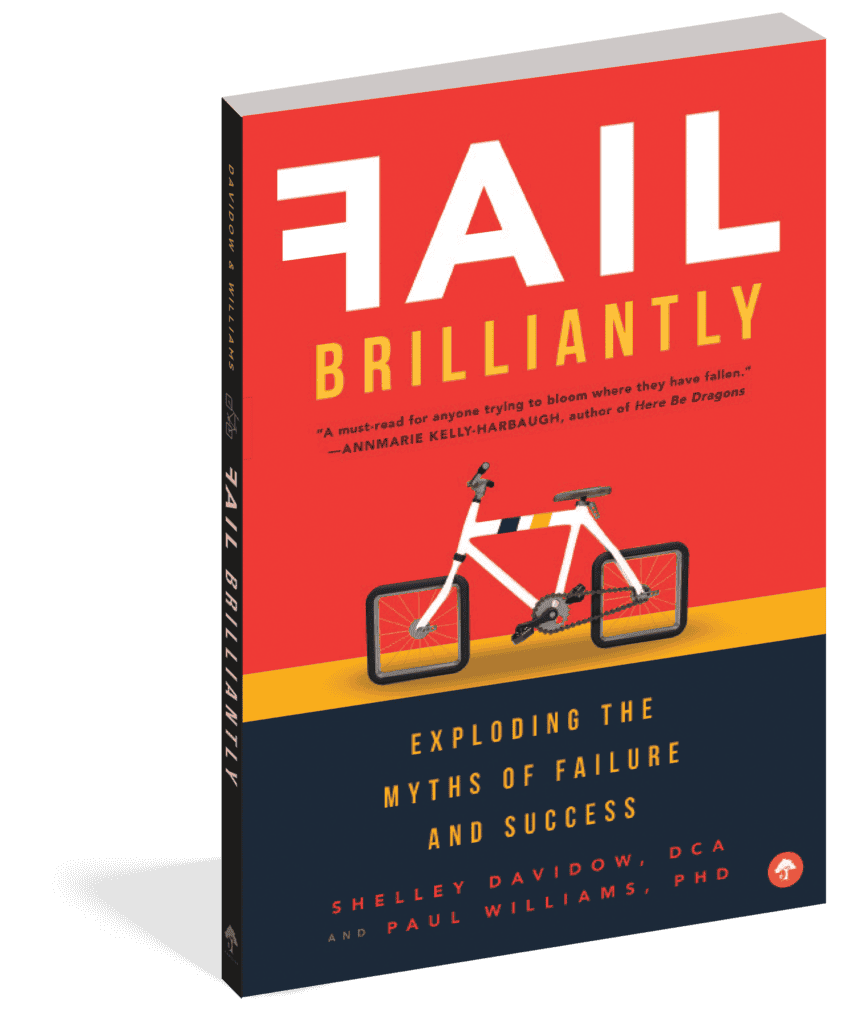
Fail Brilliantly
Excerpt from Fail Brilliantly by Shelley Davidow, DCA, and Paul Williams, PhD.