

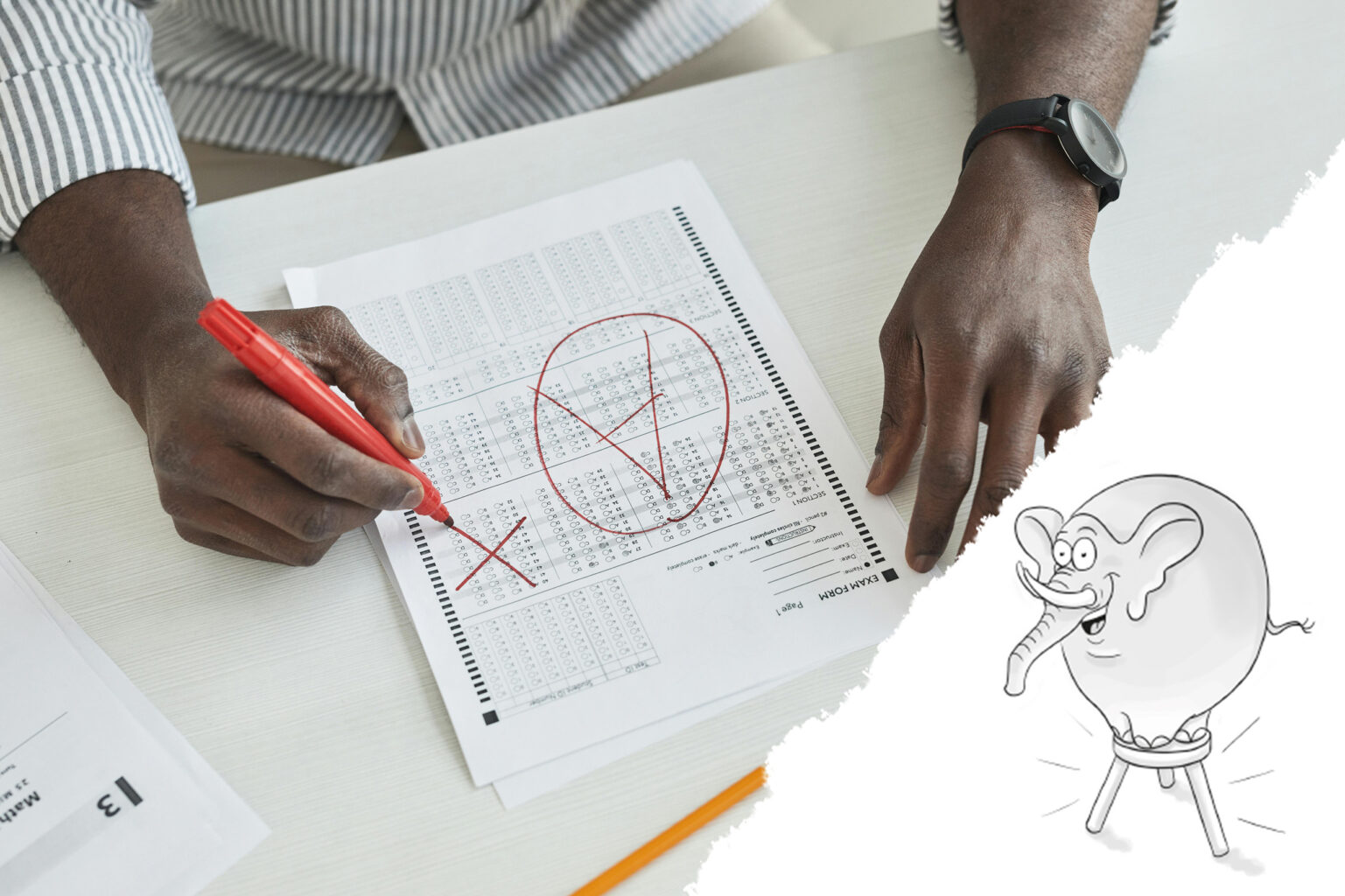
Want to crush test stress? Start by finding your balance—with this simple, powerful strategy from performance coach Ben Bernstein.
Tests don’t just measure knowledge—they also test your nerves. In this excerpt from Crush Your Test Anxiety, performance coach and clinical psychologist Dr. Ben Bernstein shares his foundational strategy for managing test stress: the “three-legged stool.” Drawing on decades of experience and insights from elite performers, Bernstein explains how balancing calm, confidence, and focus can help students perform their best—no memorization tricks or gimmicks required.
The Three-Legged Stool
Picture this: you walk into a classroom to take a test. People all around you are fidgety and nervous, gnawing their fingernails and chewing their pencils, but you stretch your legs out and think, I can handle this. Bring it on. You open the test booklet and start answering the first question, then move onto the second, and then the third. The fourth is a tough one, but you are still relaxed because your mantra is I know how to stay on course. I can work out the answer. You surge on like this from one question to the next like a fearless lion. You’re not mousing your way along; you’re pouncing.
Do you think this is a fantasy? It’s not. You can do it. You just need to learn how.
The secret is learning how to reduce the stress in your body, mind, and spirit and to keep it at an optimal level throughout the exam.
Think about what throws you off during a test. Are you rigid as a wooden plank or hyped up like a jumping bean? Either way, your body is not calm. You need it to be in a quiet, unagitated state so you can sit still long enough to do the work. Your mind cannot be undermining you by broadcasting alert warnings. Thoughts like Loser on the loose! will not boost your performance or pump up your faith in yourself during the hard questions.
And your spirit cannot desert you by becoming distracted when you need it to help you stay on task and spur you on from start to finish. You have to take that test whether you like it or not, and wishing you were someplace else is not the kind of attitude that will pivot your attention toward your goal. In fact, thinking I just want this to be over only distracts your attention from the task at hand. It increases stress because it causes you to read and think too quickly, which results in many careless errors.
Remember what I said before:
Stress is not really caused by what is happening to you from the outside; it comes from the reaction you’re having on the inside.
The answer to physical tension, negative self-messages, and fractured attention is to learn how to reconnect within yourself. This is how you lower your stress. This is how you stay in the game from start to finish and do your very best, no matter how rough it gets.
When your body, mind, and spirit work together, you have a winning team.
The steps that will ensure your success, whether you are taking a history quiz or defending your doctoral dissertation, are learning to be calm, confident, and focused. Successful test takers embody these three characteristics. Everything inside is pulling for success.
When you take a test, all of you is there in the room— body, mind, and spirit—and all three have to cooperate fully. That’s your team. When a team works toward one goal, each team member has to pull her own weight or she will let the team down. On a baseball team, for example, the outfield coordinates with the infield, the catcher works with the pitcher, the players on base are all alert to each other’s moves. But if the pitcher ignores the messages of the catcher and the third base player takes her eye off the ball thinking the shortstop should catch it, they’re not going to have a winning team. It will fragment and fall apart.
Your body, mind, and spirit are your personal team. If any one of them is absent or weak, you can’t maximize your full potential. But if they work together, each operating at top capacity, you’ll hit home runs. Every member of your team must fully participate when you face a test in order for you to reach your optimal zone. Any disconnection seriously undermines the whole team’s efforts.
Once you learn how to work with your three team members, you will notice immediately when you are disconnecting inside. More important, you’ll know how to get yourself back into the test-taking performance mode.
The secret of success, quite simply, is staying fully connected so all the members of your personal team mutually reinforce each other’s strengths.
People who flourish on tests know how to play the game. By staying connected, they keep all parts of themselves working in concert. In each of the next three chapters, I will show you specifically how to stay connected in body, mind, and spirit every time you take a test.
If you’re thinking, Is that all there is? If I stay calm, confident, and focused I can pass my tests without studying for them? The answer is of course not. You have to study the material and study well if you want to succeed. But how you study and prepare will also have a direct impact on your test performance. If, while you’re studying, you are tensing up your body, broadcasting negative messages with your mind, or becoming distracted from your higher goals, you can’t prepare well, let alone score high.
Can you be successful in an athletic competition if, when you are getting ready for it, one of your team members doesn’t show up at practice? You can’t. Teams practice strategic moves together right up until game time. Like them, you can practice training your body, mind, and spirit to work together from the day you start studying right through the last question of the test. Success doesn’t happen only at the finish line. It’s a path. You’re on it, step by step, from beginning to end.
A Model for Every Test
Practicing all three together—being calm, confident and focused— creates a dynamic, forceful unity. These three elements form a natural triad, and a triad is a powerful figure. It’s the fundamental structure of harmony in music. In geometry, a three-legged configuration is the sturdiest of structures, much more stable than one that is four-legged. The three-pointed figure always stays a triangle, unlike a square that can be pushed into a parallelogram, or a circle that can be squished into an oval. This unity of three is a potent structure. It shows up in religious traditions and symbols, and it comprises the totality of who you are: body, mind, and spirit.
When I work with clients, I hold up a three-legged stool when I introduce them to the idea that to improve their performance they need a calm body, a confident mind, and a focused spirit.
The three-legged stool, a structure that is ages old, is one of the sturdiest, most durable, and long-lasting constructions ever produced. In the past, people used it for milking cows and sitting around fireplaces. This structure forms a three-point foundation that resists toppling. Visualize one and then imagine each leg represents a different part of you. One leg is your body, one is your mind, and the third is your spirit. All three together make up the totality of who you are. They are all part of the same unified structure called “you.”
Each leg also represents what’s necessary to reduce stress and improve performance.
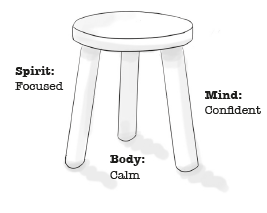
When all three legs of the stool are equally strong, it is remarkably robust, so strong, in fact, that a baby elephant can rest its full weight on it. When your body, mind, and spirit are sturdy and stable, you have a powerful platform on which to build your optimal performance. All your parts—your team members—are contributing to the integrity and potentiality of the whole.
Life is full of unavoidable challenges and you need a strong foundation to meet them successfully. If you were taking a trip across the ocean, you would want a ship that can weather any storm. If you are going camping, you want a tent that will stand up to the wind and rain. When you’re taking a test, you want to be sure you can depend on your own internal structure to withstand the challenge of difficult questions. You need to trust your “inner team” will be dependable in the face of anything the test throws at you. A strong foundation of body, mind, and spirit makes up your three-legged stool, a platform that will support you.
But what happens if one of the legs is weak or short? The stool wobbles and loses its stability.
Any leg that is weak imposes a strain on the entire system, which places excess pressure on the other two. What happens if that baby elephant tries to stand on a stool with one fragile leg? The whole thing collapses and the elephant falls on its rear end. You operate the same way. You need each leg of your stool to do its job and for all three to be equally strong. If one leg is weak, it will pull the other two down with it.
A perfect illustration of this point is the story of Alicia, a college senior.
She was applying to medical school and was about to take her MCATs. Although she usually was calm and confident enough when taking tests, Alicia often found herself distracted when preparing for them. Instead of hitting the books, she went to parties. Instead of applying herself and going over past exams, she watched late-night TV. Her habitual pattern in her courses was to cram at the last minute and enter the classroom somewhat prepared, but not completely ready. For the MCATs, however, that strategy wasn’t going to work. It was too big and too important, and it required sustained focus during preparation over a long period of time.
As the date for the test drew nearer, Alicia became noticeably tense, and she started losing her long-held belief that she could pass any test no matter how much time she wasted beforehand. This time, the fact that she was so ill-prepared ate away at her confidence and it unnerved her. The “weak leg” of Alicia’s stool was her Focus/spirit, which undermined the other two legs. By the time test day came around, her whole system was disturbed. She was physically anxious and she was lacking confidence. Her inability to focus and study had caused a weakness that her mind and body could not overcome. In other words, the weakest leg debilitated the other two. No three-legged stool can rest on only one or two legs. To pass the MCATs, Alicia had to work hard in the one area where she wasn’t pulling her weight.
The good news is that this process is dynamic:
When you strengthen any one component, it reinforces the other two.
The first time around, Alicia scored poorly on her MCATs and came in for coaching so she wouldn’t repeat the performance a second time. We identified Focus as the aspect she most had to work on, and she learned how to do it: she made a study schedule, set specific goals for herself, rewarded herself for reaching those goals, and reminded herself on a daily basis how crucial it was to attain a high score on this test. With a low score, she would literally have to choose a new career. This was high motivation for a young woman like Alicia, and she was diligent in aligning her actions with her goals.
She found that as she reinforced the one weak leg, the other legs reacted accordingly. When she went to take the test for the second time she was more relaxed and she had more faith in herself. Her score went way up, and she was accepted into medical school.
When your performance is off, you sometimes can be so thrown by it (especially if you are expecting to do much better), that you can’t immediately identify which leg is the weak one.
The beauty of the triad is that each leg is connected to the others. Whichever leg you begin with, you are immediately linked with the other two.
It doesn’t matter where you begin. This isn’t a hierarchical model where you have to start at point A and move to point B, then go from there to point C. You start where you can and then move on. Just because the paradigm is called “calm, confident, and focused,” doesn’t mean you have to work it in that order.
Alicia, for instance, worked on her Focus/spirit leg first. Once she was focused, she started to calm down. Another client, Steve, who was a high school soccer player, used the Confidence tools first. Feeling good about himself paved the way to relaxing his body and placing his attention on the task. Everyone is different, and every person will have his or her own entry point in working the model and using the tools.
What does your three-legged stool look like?
Discover More Ways to Improve Test Stress and Test Scores
Crush Your Test Anxiety
Excerpt from Crush Your Test Anxiety by Dr. Ben Bernstein.