

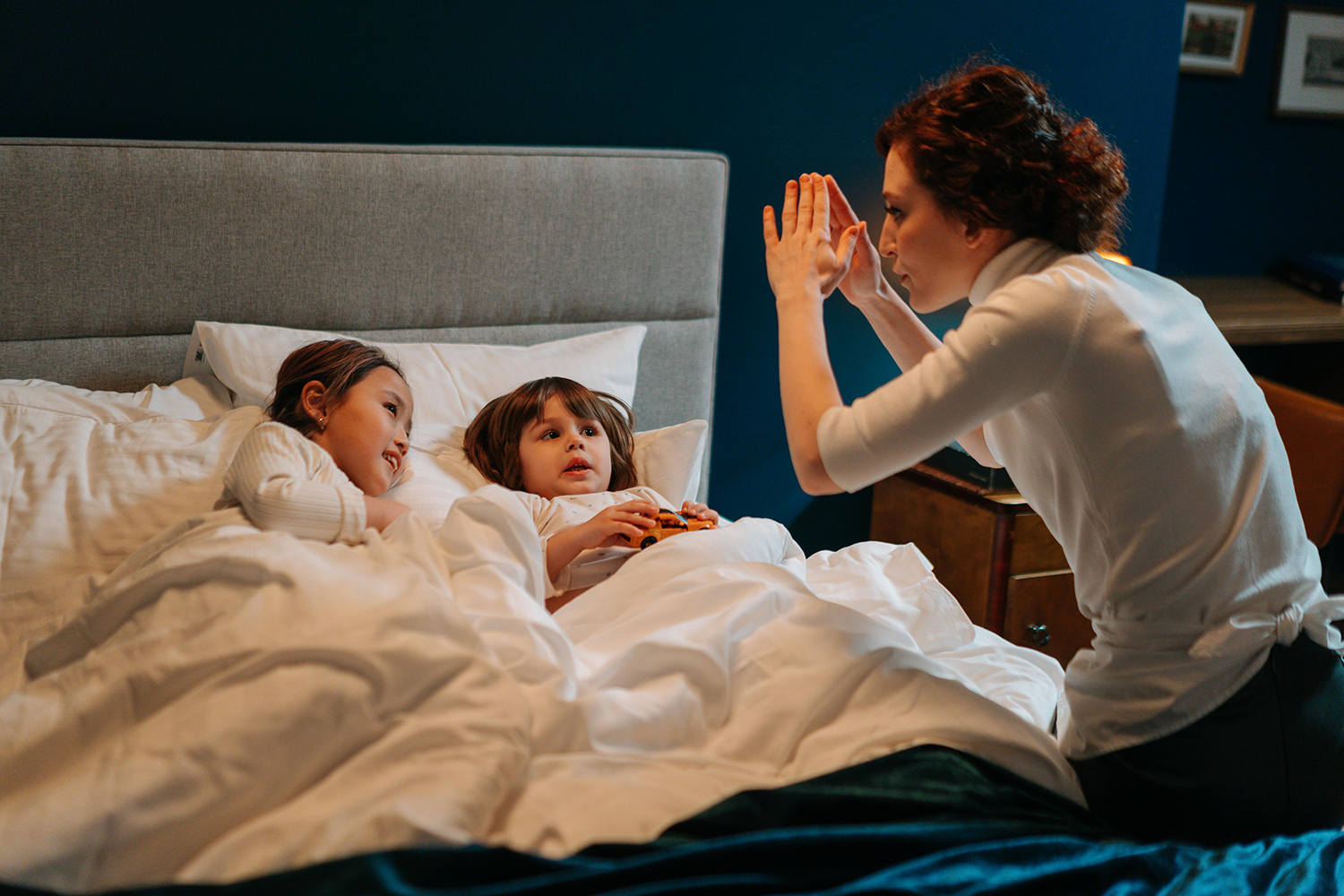
Skip the book tonight—learn how to craft a magical bedtime story from scratch and turn nighttime into a storytelling adventure!
Tonight, don’t just read your child a bedtime story—create one. Dim the lights, settle in, and let your imagination take over. In Tell Me a Story in the Dark, award-winning playwright John Olive shows parents how to weave captivating, original bedtime stories that will enchant their children and turn nighttime into a magical storytelling experience. This excerpt from the book will guide you through the art of crafting your own bedtime tales, helping you build connection, spark creativity, and transform bedtime into a moment your child will cherish forever.
How to Prepare a Bedtime Story
Let me begin here by saying:
Don’t memorize it! Never, never, never memorize a bedtime story!
Even if you had the time (and the brain capacity) to sit down with a text and incorporate it word-for-word into your memory, it wouldn’t work. You would be reciting and picturing words on paper, not the vivid reality of the story. Even if you happen to be a gifted and trained actor, reciting memorized text simply will not cut the bedtime mustard. You would be acting, pretending to be someone you are not—in this case a person with a memorized story. It’s unnatural.
More to the point: what separates oral storytelling from acting is that storytelling is personal. A storyteller, whether performing on A Prairie Home Companion for a radio audience of millions or for an audience of one in a child’s shadowy bedroom, is saying, “I have something special to share with you, something that comes from me. No one else will ever hear this story in quite the same way as you will tonight.” If you’ve memorized the story, there is a third, and foreign, personality in the room: the author of the text. You can’t have that. It has to be just you and your child.
But, I hear you say, the tales in this book are fully developed. Don’t you intend for me to memorize them, to give them to my child word-for-word?
I don’t. In this book, I present the tales as vividly as possible in hopes that they will come alive for you, so that you’ll get a clear sense of how they will work. But I certainly wouldn’t want you to memorize the material. Certain phrases, if you find them sufficiently memorable, might be used, but not, by any means, the entire text.
Here’s what you should do when you tell your child a bedtime story: read through the material a few times (depending on length and time available). Incorporate the basics of the story into your imagination, fill it with vivid sensual details, and let the story go organically where your imagination takes it.
Story Points
Once you have the basics of a given story in mind, you should create, for each telling, a set of story points. These are, simply, a list of things that you’re pretty sure will happen in tonight’s story. There may be a dozen of these points or as few as four or fi ve. You may not get through all of them. Maybe your little beauty will drop off to sleep instantly. Or maybe other story material will suggest itself. The magic of the wild, dark bedroom can spark new ideas. If a new direction emerges, follow it.
Remember, it’s quite acceptable for these stories to be free form, improvised, and repetitive. This will often get the child involved in the story, cause increased concentration, and induce sleep.
Indeed, often the unexpected material will come from the young listener: “What’s behind that tree?”
Or: “I don’t wanna hear about the crocodile. Tell me the one about the sled dogs.”
Don’t become overly fond of your brilliant story points.
Make them concrete. “Joe feels depressed,” “Carmen is confused,” or “Molly is happy,” won’t get you very far. A detail like “Molly is happy. She dances and skips,” is helpful to a point, but, again, we soon get bogged down in vagueness.
But how about this: “Joe, depressed, gets in his car and starts driving. He drives and drives.”
Much better. Useful questions come up: Why is he depressed? Did he have a fight with his dad? Where’s he going? Will he get lost? Where might he end up?”
Or: “Carmen is confused. She finds herself in strange woods. Could this be a dream? How did she get here?”
These are great story-driving questions.
It might be useful to write these points down. I often find that the physical act of writing can help get my creativity juiced. If this is true for you, spend a few minutes jotting your stories points down. It’s certainly not necessary to spend a great deal of time doing this. You may not need to do it all. You may simply want to go over them in your mind so that you’re prepared, at least on some level, when you enter your child’s dark room.
Let’s continue this “exercise” (perhaps an overstatement) with the story points I created for an original story, “Ricky Fred and His Flying Bed,” a story not included in this book:
- Small town in the Midwest.
- Beautiful summer evening—endless twilight.
- Ricky Fred is sweet and shy. His mother tells him she has to go away for a few days.
- He’ll be staying with a very weird family, the Kadiddlehoffers, in a huge Victorian house with 50 plus Kadiddlehoffers living there, etc.
- They put him in the attic, in a huge bed, under an enormous skylight. The attic is filled with shadowy corners and strange knick-knacks.
- That night, as Ricky sleeps, the roof opens up, and the bed rides. Soon it’s flying over an endless forest.
And that was it. Thus armed I went into Michael’s bedroom, and a story emerged. Of course, the story I told my son was much more detailed. My “Ricky Fred and His Flying Bed” is a multi-nighter, detailing the adventures Ricky Fred has in the enchanted forest. I described the smell of the pine trees, the chilly night air, and the way Ricky Fred’s hair whipped around as he flew. Part of the story even takes place on the moon. No doubt these points would suggest something completely different, and maybe better, to you.
Sensual Detail
Let’s quickly define this term. Sensual detail refers to the five senses: what the world of your story looks like, feels like, smells like—whether it’s hot or cold, night or day, a forest or city, etc. The term does not in any way refer to eroticism, what we grownups often call sensuality.
Children enjoy fast-moving plots, for sure, with plenty of action and nifty story ins and outs and ups and downs. They adore fully rendered characters, people they can readily identify with.
But what they want, what they really desire, more than anything is to be transported; to enter the world of the story, to be taken out of their humdrum existence and allowed to live purely in the realm of imagination. This is what they want, and this is what you, the storyteller, must provide.
How do you do this?
Easy: use rich sensual detail.
Take your time.
These details may seem peripheral to the plot(they are), but your young listener will revel in them. If they are truly entranced, they may ask you to repeat the world-spinning detail every night. “Talk about the forest.”
Indeed, extensive use of sensual detail is a major reason that these yarns are so easy to spin. For example:
What is the weather like? When Jack (in “Jack and the Beanstalk”) leads Harriet the cow to town, is he sweating in the harsh August heat? Shivering in an unusual cold snap? Is the sun shining? Or is the sky filled with ominous low scudding clouds? Is the air crisp? Hot and muggy? Or does Jack revel in the perfect warm weather?
Probably the latter (it reinforces Jack’s goofy dreaminess), but this is your choice to make, and you should definitely make it.
Don’t be vague.
What does the world look like? Is the forest Nordic, filled with stately spruces and crunchy pine needles? Or is it a jungle, dense with wild tropical undergrowth, moss dripping off the canopy-creating trees?
What can you hear? Wind in the treetops? Screaming monkeys? Hooting birds? Buzzing insects? Something in the distance? Are the sounds human? From friends? Enemies? Can you smell woodsmoke? Rotting vegetation? Or something even worse?
Is that distant firelight? A campfire! Or is something on fire? A town burning? Oh, no!
Crunch, crunch, crunch. Who’s there? Is he friendly? It’s hard to tell. His clothes are ragged, and he smells like he needs a shower. But that doesn’t necessarily mean anything. Then look into his eyes . . . is he a friend or foe?
He’s a monster! His sharp teeth gleam, and his mouth drips strings of stinky saliva. He’s ten feet tall if he’s an inch, and that laugh! It sounds like he comes from the fires of Inner Earth.
Or maybe she’s beautiful, with braided hair, a sweet smile, and a blue dress—look at those gleaming ruby slippers!
You get the idea.
Let me provide you with a quick example: the following comes from the always-popular (because it’s terrific) “Jack and the Beanstalk”:
Jack got out of bed. He stretched. Then he noticed that the light in his room was different. He ran outside and saw an enormous beanstalk, stretching up, up into the clouds. “Wow,” said Jack. “I’m gonna climb it.”
He jumped onto the stalk, and started up.
There’s nothing wrong with this. There’s some nice detail: the altered light in Jack’s room and the beanstalk reaching high into the sky. These details are excellent story devices—the first time we really come up against genuine magic.
But let’s try it again, with more compelling, sensual detail:
Jack jumped out of bed. “What a great day! Man, I’m hungry. I hope Mom isn’t mad at me anymore.”
He started pulling on his scratchy homespun clothes: first his shirt, then his overalls. He sat down and tied his boots. “Maybe she made some pancakes. Yum. Hey.”
Jack looked out the window. The sun was shining, but there was a curious shadow over the window.
“Did Mom build a new henhouse or something?”
He ran into the kitchen. “Mom? Mom, are you here?!”
“Out here, Jack.”
Jack went outside.
“Whoa.”
Outside the kitchen window, right where his mother had thrown the seeds, a beanstalk had grown—an enormous beanstalk, thick as an oak and reaching, up, up, up into the sky. It was a sunny day, but at the top of the beanstalk there were clouds, swirling and twisting, swirling and twisting.
“Wow . . . ”
Jack touched the stalk. It was woody—strong. He could feel a strange power coursing through it. There were branches growing out of it at regular intervals, like it had been built for climbing.
“What are you going to do?” his mom asked.
Jack looked at his mom, and then up at the beanstalk. “I’m gonna climb that sucker.”
He jumped onto the stalk, and started up.
I’ve stacked the deck here, but I think you get the point: the second example is more vivid, for two reasons. First, it uses richer and more exciting sensual imagery. Jack jumps out of bed, pulls on his rough clothes, sees the weird shadow, rushes outside, sees the clouds swirling around at the top of the beanstalk, and decides to climb the sucker.
Second, the latter example is longer and much less rushed. It gives the young listener the chance to savor detail, to really experience the action of the story. Your child, in a real way, becomes Jack and experiences the story close up. This will make it all the more thrilling, funny, scary, etc.
And more sleep inducing.
Here’s one specific tip that works well for me: use the ceiling as a canvas on which you, often with your hands, paint the scenery.
“We’re deep, deep in a swamp—the kind of place where lots of people get lost. Can you see the big swamp birds? They’re flying up. What are those eyes? A crocodile. Ooh.”
In other words, the ceiling functions as a blank canvas on which you, the storyteller, can paint vivid detail. The child, as she slips into the imaginative world you create, can actually see the story unfold!
Dialogue and Vocalized Thoughts
Everyone likes dialogue. Maybe it’s because we’ve been conditioned by Hollywood; dialogue is what we associate with well-written material. Beyond that, though, dialogue makes a story real, giving characters immediacy and presence. Remember the old creative writing saw: show, don’t tell. Dialogue shows.
For example, you could say:
Cinderella’s Step-Mother was nasty and shrewish. She made poor Cinderella do degrading tasks—just because she enjoyed it.
The same with Cinderella’s step-sisters. Poor Cinderella was the family goat, the one blamed for everything and punished severely.
Again, nothing wrong here. It’s valid, and it portrays Cinderella’s
pathetic situation vividly. But see how a little dialogue can
spice things up:
“Cinderella!” Step-Mother was livid. “Cinderella!”
Cinderella stuck her head up from the cellar. She had been working on the laundry. “Yes, Step-Mother?”
“There is dust in the kitchen.”
“Dust?”
“Dust!”
“That’s not possible. I cleaned the kitchen this morning.”
“See for yourself!”
Cinderella followed the angry step-mother into the kitchen. She pointed a shaking finger at some white stuff, behind a jar.
“That’s not dust—it’s flour. I made some bread. I must have missed that spot.”
“You will clean the entire kitchen again. The counters, the shelves, the floor!”
“The whole kitchen?”
“Yes!”
The step-mother marched off. Cinderella got out the mop and pail. She worked slowly, feeling woozy—she hadn’t had any breakfast.
The ugly step-sisters appeared, smiling.
There is another kind of dialogue. This occurs when a character speaks to him or herself. No doubt you’ve heard the expression, “He gave himself a good talking to.” When a character deals with a quandary, as they often do in these heightened stories, there is often an important decision to be made. When this happens, dialogue-with-oneself can be very useful:
Jack looked up at the beanstalk, rising up, up, up into the clouds. He hesitated. “Wow,” he said to himself, a big grin forming on his face, “I’m gonna climb that sucker!”
Or:
Little Red Riding Hood suddenly stopped. She listened. Crunch, crunch, crunch. “Could that be a . . . ? A . . . ?” She heard it again. Crunch, crunch, crunch. Even closer. “I bet it’s a wolf!” Little Red Riding Hood hurried down the path, her heart pounding.
Internal dialogue brings characters to life. Use it liberally.
Dialogue is, in itself, a sensual detail. When you give the characters a voice, you are appealing to a very powerful sense: hearing. This kind of sensual detail, the use of external and internal dialogue, plays a central role in every yarn in this book. As you read, you will, I trust and hope, emphatically get the idea.
The Rule of Threes
The Rule of Threes is a useful and powerful structural device. Often things happen three times. Jack climbs the beanstalk thrice. Dorothy has three allies in The Wizard of Oz: the Scarecrow, the Tin Man, and the Cowardly Lion. She taps the ruby slippers together three times. Cinderella has three family members: two ugly stepsisters and an even uglier stepmother. There are three blind mice, three bears, three stooges, three musketeers, three little pigs, etc. When Chuck goes back to the haunted house for the third time, all heck breaks loose. That things happen three times isn’t inevitable, but it’s common, especially in stories as short and pithy as bedtime tales.
Be aware of the progression: narrative tension is established in the first iteration, intensified in the second, then released in the third, in a way that feels logical and satisfying. The use of this device can make a story feel polished and dramatic, even when it’s largely improvised, made up on the spot.
Winging It
Now that we’ve gone over some story prep tools, I should mention another crazy possibility: you can, if you wish (and if you possess the intestinal fortitude), wing it. This is an old theatre term. It means to take the stage with no idea at all of what you’re going to do or say. Your performance will be improvised, made from whole cloth. You could, if you have the confidence, march yourself into Joey’s room without the first idea of what the story might be.
Can you? Really?
I don’t recommend it for everyone, but it’s possible. Winging it has several clear advantages. For a start, prep time is zero. Also, it’s fun. You’re flying (well, telling) by the seat of your pants, as caught up in the suspense as your kid. What’s gonna happen next? You better figure it out ASAP.
Winging it may not be as nerve-racking as it sounds. The darkened bedroom and the larger-than-life presence of the child can inspire you. The ideas that come unbidden into your mind can be quite good.
The first story I told Michael, “Ralph, the Sad, Sad Ghost,” was completely off-the-cuff. When I went into his room, I didn’t even know I was going to tell a story, much less what the story might be.
But something happened that night between Michael and me. The darkness of the room, Michael’s wide-eyed attention, the intense connection taking place between us—whatever it was, it made the story flower. Ideas flowed. I saw that strange house by the overgrown apple orchard, the “wisps of sadness” floating in the air. The characters, Chuck, Madeleine, and Nancy, came alive for me.
I was inspired, and I mean that quite literally.
So, consider winging it. After all, you love Junior with an intensity that reaches deep into the core of your being. And when you feel her there, waiting, expectant, wanting to listen to you, looking to you for guidance and story material that will help her make sense of the scary world she lives in, you will instinctively and immediately understand that you are engaged in an ancient and vital exchange. You will rise to the challenge. You may not be an experienced and polished storyteller, but you are a committed parent (or family member or family friend), and this will make you a wonderful storyteller.
Inspiration happens. Trust it.
Discover More Tips for Telling Bedtime Stories from Scratch

Tell Me a Story in the Dark
Excerpt from Tell Me a Story in the Dark by John Olive.